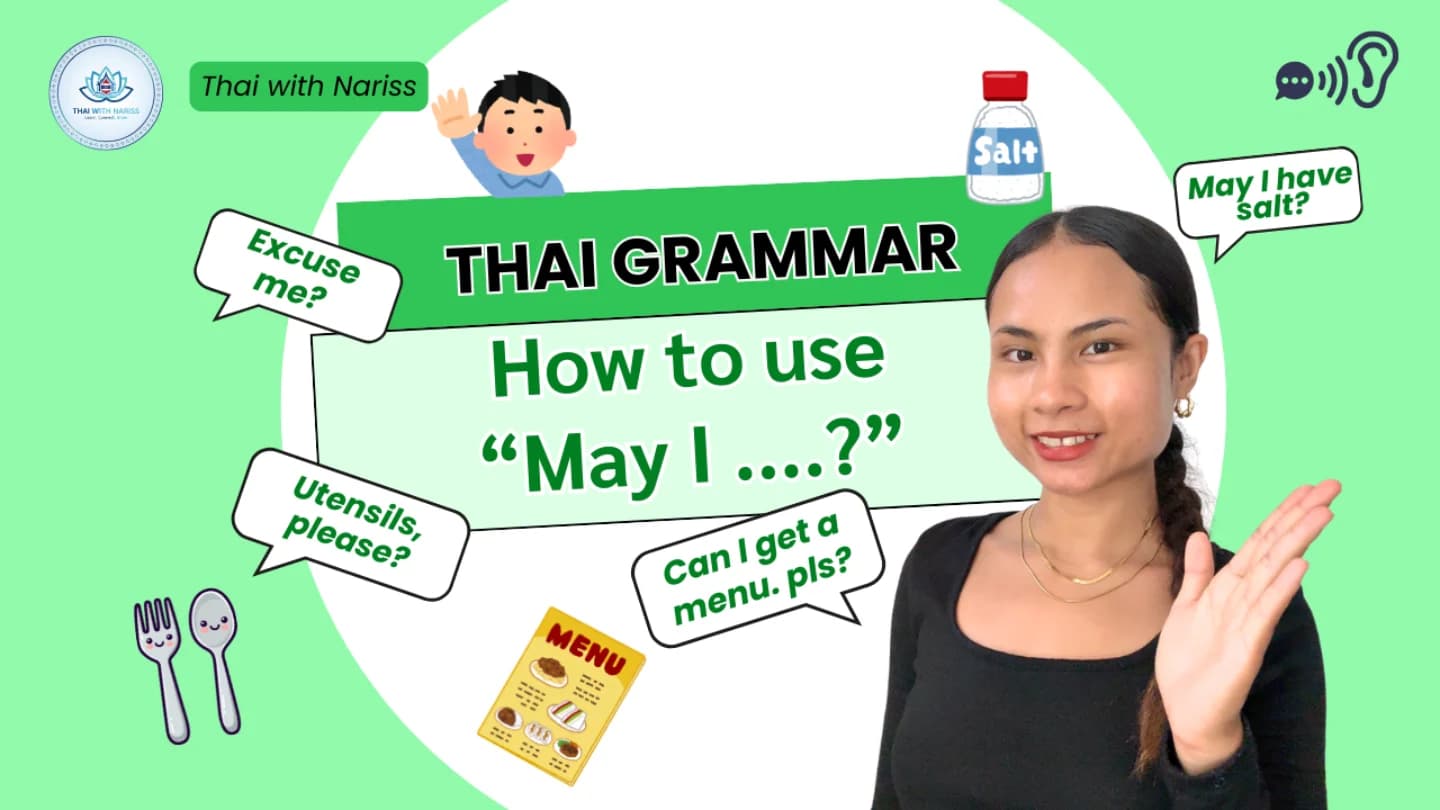
Ordering food, asking for a bag, requesting the menu. These are situations you run into every single day in Thailand, and two short phrases cover almost all of them. Both start with ขอ (khǎw), which roughly means “to request,” but they differ in tone and formality.
Below you will find both patterns explained with real examples, followed by twelve vocabulary words you can plug straight into either phrase at a restaurant or a market. Watch the video first to hear the pronunciation, then practice with the vocabulary list.
Video
Pattern 1: ขอ...ได้ไหมคะ/ครับ?
This is the slightly more formal version. You are asking permission: “May I have...?” Use it when you want to be extra polite or when the request is not routine.
ขอ...ได้ไหมคะ/ครับ?
khǎw ... dâi mái khá/kháp?
“May I have...?” (asking permission, slightly more formal)
Pattern 2: ขอ...หน่อยค่ะ/ครับ
This is the softer, everyday version. It feels closer to “Could I please have...?” and works perfectly for routine requests at a restaurant, a market, or a coffee shop.
ขอ...หน่อยค่ะ/ครับ
khǎw ... nàwy khâ/kráp
“Could I please have...?” (softer, everyday request)
Quick tip: Use คะ/ค่ะ if you are a woman, ครับ if you are a man. These polite particles are an important part of sounding natural in Thai!
Vocabulary to Practice With
| Thai | Pronunciation | English |
|---|---|---|
| ช้อน | cháwn | spoon |
| ส้อม | sâwm | fork |
| ช้อนส้อม | cháwn-sâwm | spoon and fork |
| มีด | mîit | knife |
| ที่รองแก้ว | thîi-rawng-gâew | coaster |
| หลอด | làwt | straw |
| ถุง | tǔng | bag |
| พริกไทย | phrík-Thai | pepper |
| เกลือ | gleua | salt |
| น้ำตาล | náam-dtaan | sugar |
| น้ำปลา | náam-bplàa | fish sauce |
| เมนู | may-nuu | menu |
ช้อน
cháwn
spoon
ส้อม
sâwm
fork
ช้อนส้อม
cháwn-sâwm
spoon and fork
มีด
mîit
knife
ที่รองแก้ว
thîi-rawng-gâew
coaster
หลอด
làwt
straw
ถุง
tǔng
bag
พริกไทย
phrík-Thai
pepper
เกลือ
gleua
salt
น้ำตาล
náam-dtaan
sugar
น้ำปลา
náam-bplàa
fish sauce
เมนู
may-nuu
menu
Example Sentences
ขอช้อนได้ไหมคะ?
Khǎw cháwn dâi mái khá?
May I have a spoon?
ขอหลอดหน่อยครับ
Khǎw làwt nàwy kráp
Could I have a straw, please?
ขอเมนูหน่อยค่ะ
Khǎw may-nuu nàwy khà
Could I see the menu, please?
ขอถุงได้ไหมคะ?
Khǎw tǔng dâi mái khá?
May I have a bag?
Practice
Pick three items from the vocabulary list above and build your own sentences using both patterns. For example, try asking for salt using ขอ...ได้ไหม first, then switch to ขอ...หน่อย. Notice how the second version feels a bit softer. Once you can swap between the two without thinking, you are ready for any restaurant in Thailand.
If you want to learn more everyday Thai phrases for real situations, check out how to ask for help in Thai. Ready for a structured path from zero to conversational? Nariss's video courses cover beginner through advanced with practice exercises built in.