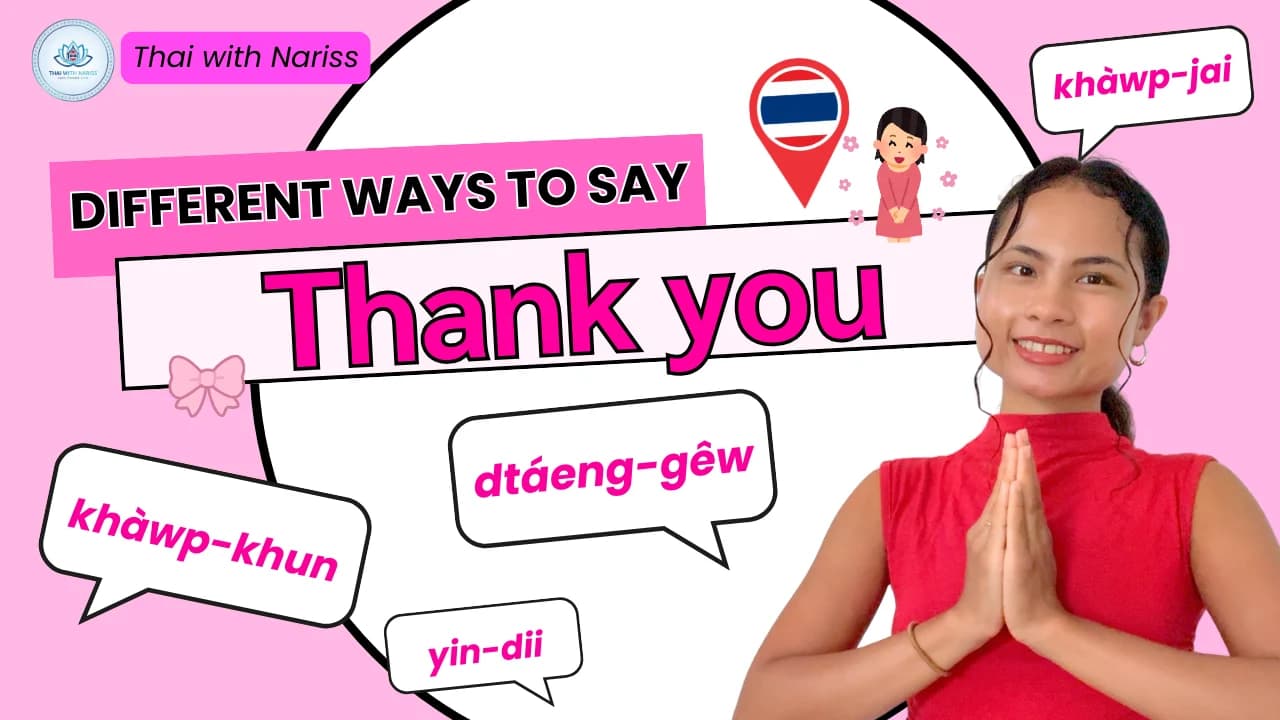
To say thank you in Thai, say khop khun (ขอบคุณ). A man adds khrap (ครับ) and a woman adds kha (ค่ะ), giving khop khun khrap and khop khun kha. For extra warmth, add maak (มาก) to mean thank you very much. A wai, the slight bow with palms together, makes it more sincere.
Thais say thank you constantly: to the 7-Eleven cashier, to the auntie who hands you extra chili sauce. If you already know how to say hello in Thai, the logic here is identical: one core phrase, plus a polite particle that depends on your own gender. Let me walk you through it the way I do with my students.
Video
Khop Khun: The Thai Word for Thank You
Khop khun (ขอบคุณ) is the standard thank you in the Thai language, pronounced khàwp-khun with a short, closed "p" at the end of the first syllable. On its own it sounds bare, so in everyday speech you attach the polite particle: khráp if you are a man, khà if you are a woman. The particle follows the speaker, never the listener.
| Thai | Pronunciation | English |
|---|---|---|
| ขอบคุณครับ | khàwp-khun khráp | Thank you (male speaker) |
| ขอบคุณค่ะ | khàwp-khun khà | Thank you (female speaker) |
| ขอบคุณ | khàwp-khun | Thanks (plain, between close friends) |
ขอบคุณครับ
khàwp-khun khráp
Thank you (male speaker)
ขอบคุณค่ะ
khàwp-khun khà
Thank you (female speaker)
ขอบคุณ
khàwp-khun
Thanks (plain, between close friends)
Thank You Very Much in Thai
To say thank you very much in Thai, add maak (มาก), which means "a lot", before the particle. That is the right level when someone returns your lost phone or carries your suitcase up the stairs. Doubling it to maak maak turns the warmth up another notch, and Thais do this all the time.
| Thai | Pronunciation | English |
|---|---|---|
| ขอบคุณมากครับ | khàwp-khun mâak khráp | Thank you very much (male speaker) |
| ขอบคุณมากค่ะ | khàwp-khun mâak khà | Thank you very much (female speaker) |
| ขอบคุณมากๆ | khàwp-khun mâak-mâak | Thanks so much (warm, informal) |
ขอบคุณมากครับ
khàwp-khun mâak khráp
Thank you very much (male speaker)
ขอบคุณมากค่ะ
khàwp-khun mâak khà
Thank you very much (female speaker)
ขอบคุณมากๆ
khàwp-khun mâak-mâak
Thanks so much (warm, informal)
Formal and Casual Ways to Say Thanks
Thai has registers above and below the standard khop khun. Going up: khàwp-phrá-khun, used toward monks, elders you deeply respect, or in formal speeches and business letters. Going down: khàwp-jai, said to children, younger friends, or staff much younger than you. Say khàwp-jai to an elder and it sounds rude, so when in doubt stay with khop khun.
| Thai | Pronunciation | English |
|---|---|---|
| ขอบพระคุณครับ / ขอบพระคุณค่ะ | khàwp-phrá-khun khráp / khà | Thank you (very formal, elders and ceremonies) |
| ขอบใจ | khàwp-jai | Thanks (casual, to younger people or friends) |
| ขอบใจนะ | khàwp-jai ná | Thanks! (casual and affectionate) |
ขอบพระคุณครับ / ขอบพระคุณค่ะ
khàwp-phrá-khun khráp / khà
Thank you (very formal, elders and ceremonies)
ขอบใจ
khàwp-jai
Thanks (casual, to younger people or friends)
ขอบใจนะ
khàwp-jai ná
Thanks! (casual and affectionate)
How to Respond to Thank You in Thai
The most common reply is mâi bpen rai (ไม่เป็นไร), literally "it's nothing". It covers "you're welcome", "no problem", and "don't worry about it" all at once. In shops and hotels you will also hear yin-dii, "with pleasure", which is a touch more formal. Add your own khráp or khà to either.
| Thai | Pronunciation | English |
|---|---|---|
| ไม่เป็นไร | mâi bpen rai | You're welcome / It's nothing |
| ยินดีครับ / ยินดีค่ะ | yin-dii khráp / yin-dii khà | My pleasure (polite, service settings) |
| ด้วยความยินดี | dûay khwaam yin-dii | With pleasure (formal) |
ไม่เป็นไร
mâi bpen rai
You're welcome / It's nothing
ยินดีครับ / ยินดีค่ะ
yin-dii khráp / yin-dii khà
My pleasure (polite, service settings)
ด้วยความยินดี
dûay khwaam yin-dii
With pleasure (formal)
The Wai: Saying Thank You with Your Hands
A wai, palms together at chest level with a small bow of the head, turns a spoken thank you into a sincere one. Use it when someone has genuinely helped you: a stranger who walked you to the right pier, or your partner's parents after dinner.
Common Mistakes
The big one is borrowing the wrong particle. A man thanking a woman still says khráp, because the particle marks the speaker. Hearing a man say khà is the single most common mix-up I correct in lessons.
Second, the missing "p". Many visitors say "kaw kun" because English speakers usually release the final p, while in Thai it stays unreleased. Close your lips briefly at the end of khàwp, like stopping yourself mid-word, and it instantly sounds more Thai.
Third, skipping thanks for small services. In Thailand you thank the person who bags your groceries and the driver when you get off the songthaew. It costs you two syllables and shapes how warmly people treat you.
Practice
How would you thank each person below? Say it out loud, then check the answers. Answers are given for a female speaker; swap khà for khráp if you are a man.
- A waiter refilling your water.
- A stranger who chased you down to return your dropped wallet.
- Your close Thai friend, younger than you, lending you a pen.
| Thai | Pronunciation | English |
|---|---|---|
| ขอบคุณค่ะ | khàwp-khun khà | 1. Thank you (everyday politeness) |
| ขอบคุณมากๆ ค่ะ | khàwp-khun mâak-mâak khà | 2. Thank you so much, with a wai |
| ขอบใจนะ | khàwp-jai ná | 3. Thanks! (casual, younger friend) |
ขอบคุณค่ะ
khàwp-khun khà
1. Thank you (everyday politeness)
ขอบคุณมากๆ ค่ะ
khàwp-khun mâak-mâak khà
2. Thank you so much, with a wai
ขอบใจนะ
khàwp-jai ná
3. Thanks! (casual, younger friend)
Khop khun is one of the 100+ basic Thai phrases I teach every student first. And if a trip is coming up, my Thai for Travelers course picks up where this article stops: ordering food, taking taxis, bargaining at the market, all with native audio.