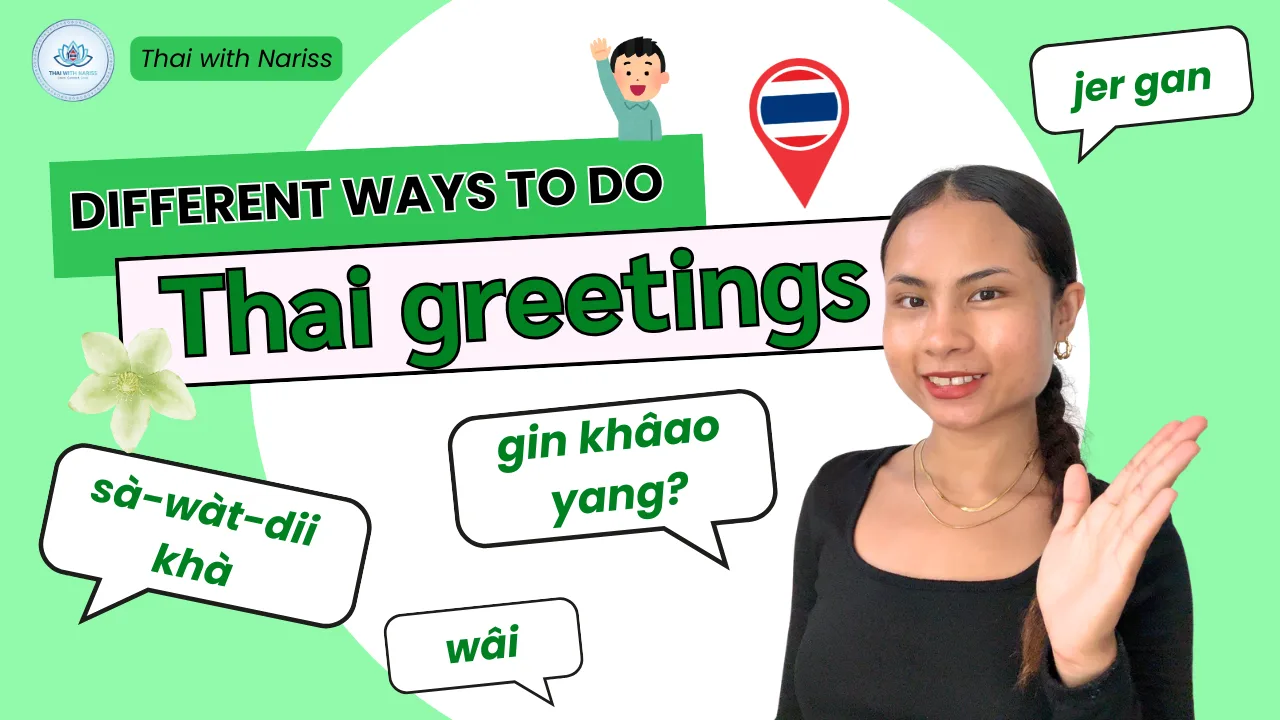
Thai greetings center on one word and one gesture: sà-wàt-dii (สวัสดี), commonly written sawasdee, spoken as sà-wàt-dii khráp by men and sà-wàt-dii khà by women, and the wâi, palms pressed together with a slight bow. Around them sits a whole family of greetings, from have you eaten yet to phone hellos and goodbyes.
Most of my students learn sà-wàt-dii on the plane, then freeze at everything that comes after: how high to raise their hands, or what to answer when an auntie asks if they have eaten. This guide covers the rest. Sà-wàt-dii itself, with the full pronunciation and casual forms, has its own guide: how to say hello in Thai.
Sà-wàt-dii: The Greeting That Works All Day
Sà-wàt-dii (สวัสดี), commonly written sawasdee, is the anchor of every Thai greeting. It works in the morning, at midnight, on the phone, and in writing. The polite particle at the end follows the speaker's gender: a man says khráp, a woman says khà, no matter who they are talking to.
| Thai | Pronunciation | English |
|---|---|---|
| สวัสดีครับ | sà-wàt-dii khráp | Hello (male speaker) |
| สวัสดีค่ะ | sà-wàt-dii khà | Hello (female speaker) |
สวัสดีครับ
sà-wàt-dii khráp
Hello (male speaker)
สวัสดีค่ะ
sà-wàt-dii khà
Hello (female speaker)
That is the short version, and for many trips it is enough. The hello article linked above breaks down the pronunciation syllable by syllable and adds the casual forms Thais use with friends.
The Wâi: How Thai People Greet Each Other
The wâi (ไหว้) is the palms-together gesture you see everywhere in Thailand, and it carries a quiet grammar of its own. The height of your hands signals respect. Between friends and peers, fingertips stay at chest level with a small nod. For elders, teachers, and anyone senior to you, raise the thumbs to your nose and bow a little deeper. For monks, and only for monks and sacred contexts, the thumbs come up between the eyebrows.
| Thai | Pronunciation | English |
|---|---|---|
| ไหว้ | wâi | The palms-together greeting gesture |
ไหว้
wâi
The palms-together greeting gesture
The younger or junior person wâis first, and the senior person returns it with a smaller wâi or simply a nod. When hotel staff or a shop assistant wâis you as part of their job, a warm smile back is already the right answer, and you are also welcome to wâi back if you like, because in Thai culture we show respect to everyone. Where a wâi truly matters is with your Thai teacher, your partner's parents, and the elders you are meeting for the first time.
Time-of-Day Greetings in Thai
Thai does have good morning and good night: arun sawat (อรุณสวัสดิ์) and ratri sawat (ราตรีสวัสดิ์). What surprises learners is how rarely Thais say them out loud. Sà-wàt-dii covers every hour of the day, so the time-specific greetings live mostly on morning TV and in romantic goodnight texts. I unpack when each one actually gets used, including fan dee for sweet dreams, in my guide to good morning and good night in Thai.
Have You Eaten Yet? The Real Thai Hello
Walk past a Thai neighbor at lunchtime and instead of sà-wàt-dii you will often hear gin khâao yang: have you eaten rice yet? It is not an invitation and nobody is checking your diet. It is warmth, the Thai equivalent of asking how you are doing, because in Thailand care is measured in meals. A short answer is all that is expected.
| Thai | Pronunciation | English |
|---|---|---|
| กินข้าวยัง | gin khâao yang? | Have you eaten yet? (friendly greeting) |
| ยังไม่กิน | yang mâi gin | Not eaten yet. |
| กินแล้ว | gin láew | I've eaten already. |
| ยัง | yang | Not yet. |
กินข้าวยัง
gin khâao yang?
Have you eaten yet? (friendly greeting)
ยังไม่กิน
yang mâi gin
Not eaten yet.
กินแล้ว
gin láew
I've eaten already.
ยัง
yang
Not yet.
Answering the Phone in Thai
On the phone, Thais usually skip sà-wàt-dii and open with han-lǒo, the Thai-flavored hello borrowed from English. It is informal and universal between friends and family. For business calls, or when an unknown number rings, sà-wàt-dii khráp or sà-wàt-dii khà keeps things professional.
| Thai | Pronunciation | English |
|---|---|---|
| ฮัลโหล | han-lǒo | Hello? (answering the phone, informal) |
| สวัสดีค่ะ / สวัสดีครับ | sà-wàt-dii khà / khráp | Hello (answering formally) |
ฮัลโหล
han-lǒo
Hello? (answering the phone, informal)
สวัสดีค่ะ / สวัสดีครับ
sà-wàt-dii khà / khráp
Hello (answering formally)
How to Say Goodbye in Thai
Textbooks teach laa gàwn (ลาก่อน) for goodbye, but in daily life it sounds heavy, almost final, like you are leaving for years. What Thais actually say when leaving is bpai gàwn ná, "I'm off now", or jer gan mài, "see you again". And sà-wàt-dii works here too: the same word that opens a conversation can close one.
| Thai | Pronunciation | English |
|---|---|---|
| ไปก่อนนะ | bpai gàwn ná | I'm heading off (casual, everyday) |
| เจอกันใหม่ | jer gan mài | See you again |
| โชคดีนะ | chôok dii ná | Good luck (a warm send-off) |
| ลาก่อน | laa gàwn | Goodbye (formal, long partings) |
| แค่นี้ก่อนนะ | khâae níi gàwn ná | That's it for now (when you are about to hang up the phone) |
ไปก่อนนะ
bpai gàwn ná
I'm heading off (casual, everyday)
เจอกันใหม่
jer gan mài
See you again
โชคดีนะ
chôok dii ná
Good luck (a warm send-off)
ลาก่อน
laa gàwn
Goodbye (formal, long partings)
แค่นี้ก่อนนะ
khâae níi gàwn ná
That's it for now (when you are about to hang up the phone)
Greeting Do's and Don'ts
Do greet before you ask. Walking up to a market vendor and pointing at the mangoes without a sà-wàt-dii feels abrupt in Thailand; greet first and the whole exchange softens. Do keep your own particle: the khráp or khà follows your gender, not the listener's, and the same logic applies when you say thank you in Thai.
Don't wâi children, waiters, or shop staff; a nod and a smile return their greeting without making anyone uncomfortable. Don't hug or kiss Thai elders when meeting them, even warmly; the wâi is the affectionate gesture. And don't stress about getting the wâi perfectly right. Thais notice the effort long before they notice the technique.
Practice
How would you greet each person below? Say it out loud, gesture included, then check the answers. Answers are for a female speaker; swap khà for khráp if you are a man.
- Your Thai friend's mother, meeting her for the first time.
- A neighbor who calls out "gin khâao yang?"
- Leaving a dinner with friends, heading home early.
| Thai | Pronunciation | English |
|---|---|---|
| สวัสดีค่ะ | sà-wàt-dii khà | 1. Hello, with a wâi raised to the nose |
| กินแล้วค่ะ | gin láew khà | 2. I've eaten already (polite) |
| ไปก่อนนะ เจอกันใหม่ | bpai gàwn ná, jer gan mài | 3. I'm off, see you again |
สวัสดีค่ะ
sà-wàt-dii khà
1. Hello, with a wâi raised to the nose
กินแล้วค่ะ
gin láew khà
2. I've eaten already (polite)
ไปก่อนนะ เจอกันใหม่
bpai gàwn ná, jer gan mài
3. I'm off, see you again
Birthdays have their own greeting. I cover it in how to say happy birthday in Thai.
Greetings are the front door to the 100+ basic Thai phrases I teach every student. And if Thailand is on your calendar, my Thai for Travelers course takes you from the first sà-wàt-dii to ordering food and taking taxis, all with native audio.