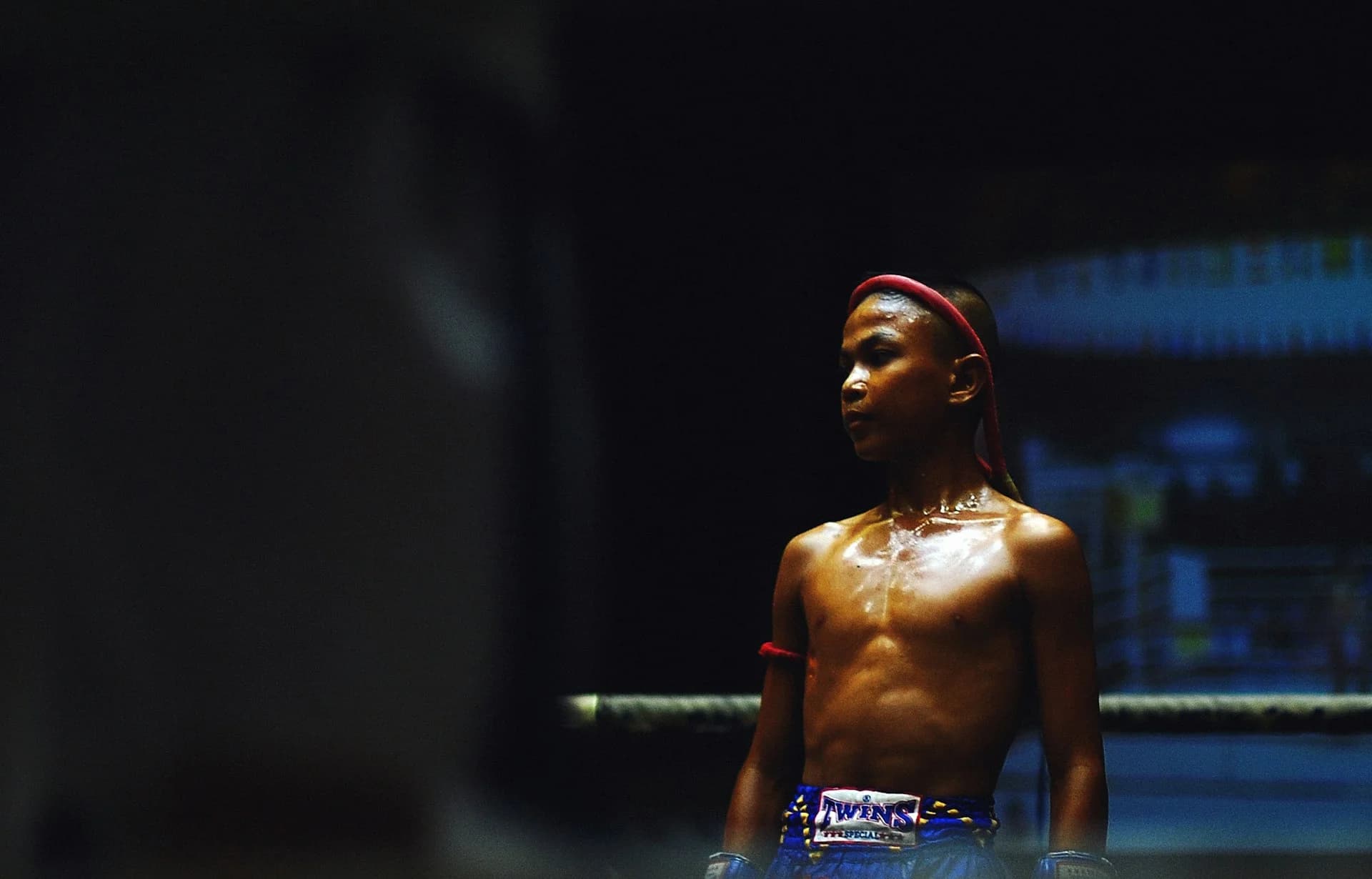
There is a moment in every Muay Thai stadium in Thailand when the music shifts. The pi java oboe rises, the klong khaek drums accelerate, and two fighters face each other in the ring with an expression that is not aggression but something more concentrated. If you have never watched Muay Thai live, the atmosphere is difficult to describe from the outside. If you have watched it, you probably came away with questions you did not know how to ask.
I grew up on Koh Samui, and Muay Thai was always part of the landscape, from the training camps along the inland roads to the fighters who came to the island from every province in Thailand. Over the years, some of my private students have been competitive fighters or serious gym members who wanted to understand the sport more deeply. That experience is part of why I developed a dedicated Muay Thai vocabulary course. But the language is only one layer of what makes this art worth understanding.
A History Shaped by War and Ceremony
Muay Thai was codified as a military fighting system during the Ayutthaya period, roughly between the fourteenth and eighteenth centuries. Thai soldiers trained in it as a battlefield skill, using their entire body as a weapon when swords and spears were no longer an option. The techniques that became Muay Thai reflected that practical origin: strikes designed for close quarters, clinch positions that controlled an opponent's body, and attacks using surfaces that could not be taken away.
After the fall of Ayutthaya, Muay Thai evolved from a military necessity into a national sport. King Rama V was an enthusiastic patron, and organised matches drew crowds from across the country. By the early twentieth century, formal rules, weight classes, and gloves had been introduced, and the sport began attracting international attention. Today it is practised in gyms on every continent, but the heart of it remains in Thailand.
The Art of Eight Limbs
Western boxing uses two points of contact: the fists. Muay Thai uses eight: fists, elbows, knees, and shins. Each surface has its own purpose and its own range. The shin, for instance, is hardened through years of repetitive conditioning until it can land a round kick with force that most people cannot absorb comfortably. The elbow works at close range and can open cuts quickly. The knee is a clinch weapon, devastating when a fighter controls the back of an opponent's neck.
Understanding these eight contact points changes how you watch a match. What looks like two people exchanging blows becomes a tactical conversation: who controls the distance, who breaks the clinch, who manages their energy across five rounds. Thai judges score Muay Thai differently from Western boxing, weighting power and composure over volume, which is why the final two rounds often determine the outcome regardless of what happened earlier.
Training in Thailand
The four cities most associated with serious Muay Thai training are Bangkok, Chiang Mai, Phuket, and Koh Samui. Each has its own character. Bangkok's camps tend to be the most competitive, particularly in the areas around Lumpinee and Rajadamnern stadiums, where fighters train with the explicit goal of performing on those stages. Chiang Mai attracts a mix of competitive Thais and international students drawn to the cooler climate and the more relaxed pace. Phuket has a large network of gyms oriented toward foreign fighters, with facilities built for long-stay trainees.
Koh Samui is smaller but has a real Muay Thai presence. Several camps operate around the Chaweng and Lamai areas, and the island's tourist infrastructure means it is a practical place to train while also managing accommodation and daily life. The fighters who train here include competitive Thais preparing for regional bouts, international visitors on training holidays, and a growing number of people who simply want to learn the art seriously without the intensity of a full competition camp. If you are on the island and looking for a gym, the north and west of Chaweng and the roads inland from Lamai are good places to look.
The Cultural Rituals: Wai Kru and Beyond
Before any competitive Muay Thai bout begins, both fighters perform the Wai Kru Ram Muay. This is not a warm-up routine. It is a ceremony, and it carries the weight of everything that word implies.
The Wai Kru portion is an act of respect directed toward the fighter's teacher, their family, and the spirit of the sport itself. The Ram Muay is the individual performance that follows, a stylised dance whose movements differ by gym and region. Some Ram Muay sequences have been passed down within a single gym for generations. Watching a fighter perform their Ram Muay is, in a real sense, watching them say where they come from.
Two sacred objects are central to this ritual. The Mongkon (มงคล) is a headband blessed by the fighter's kru and worn during the Wai Kru. It is removed before the bout begins and never touches the ground. Fighters do not put it on themselves; the kru places it, and the kru removes it. The Pra Jiad (ประเจียด) are fabric armbands worn during the fight, often made from a piece of clothing belonging to a loved one or woven with sacred thread. Both objects represent protection and intention, and treating them with carelessness inside a gym is considered genuinely disrespectful.
The discipline extends beyond ceremony. Students bow when entering and leaving the ring. They do not step over equipment or walk across someone's training mat without permission. New members are expected to observe before they participate. These are not arbitrary rules. They reflect the understanding that a gym is a place of real transmission, where knowledge passes from teacher to student, and that transmission carries obligations on both sides.
The Stadium Experience
Watching Muay Thai at a live stadium is something a gym session cannot replicate. The traditional music, played throughout every round by a live band, changes tempo with the action in the ring. As a round intensifies, the music accelerates; if a fighter lands something significant, you hear it in the drums before the crowd responds. Experienced spectators read the music as much as the bout.
The stadiums at Lumpinee and Rajadamnern in Bangkok are the most famous, but regional venues across the country carry the same atmosphere at a more accessible scale. On Koh Samui, stadium nights attract both locals and visitors, and the crowd is genuinely mixed in terms of background and experience. It is worth going at least once, not just for the sport but for what it tells you about how Thailand celebrates physical culture.
Health, Fitness, and What the Training Actually Does
Muay Thai training is cardiovascular work, strength conditioning, and technical skill practice simultaneously. A standard session includes rope skipping, shadow boxing, pad work, heavy bag rounds, and clinch drilling, often totalling two hours at a competitive gym. The cardiovascular adaptation is significant within a few weeks. Flexibility improves as the hip flexors and hips are used constantly in kicks and knee strikes. The concentration required for technical work has a meditative quality that many practitioners describe as the main reason they keep training well past any fitness goal.
There is also the mental dimension that is harder to quantify but consistently reported. Training in a Muay Thai gym requires you to be present. You cannot be distracted when someone is holding pads for you or when you are learning a new combination. That enforced presence, over time, tends to carry into the rest of life in ways people do not fully anticipate when they sign up.
Why Language Matters in the Gym
If you train at a Thai gym, your kru will teach in Thai. Some gyms have adapted for international students by mixing in English, but the corrections, the counts, the commands, and the encouragement will come in Thai first. Understanding even a working vocabulary changes the dynamic. You stop waiting for the gesture that accompanies the instruction and start responding to the word itself. That half-second difference matters in technique work.
Beyond the practical, speaking some Thai to your trainer and fellow students signals something real. It says you are not treating the gym as a tourist activity. Thai trainers notice this, and the quality of instruction you receive tends to reflect it. Students who make the effort to learn the language are given more time, more correction, and often access to the parts of a technique that are not explained in the tourist-facing session.
Our Muay Thai Thai language course was built specifically for this situation: fighters and gym members who want to communicate with their trainers, understand commands, and engage with the cultural context of what they are practising. If you want to pair that with personal practice sessions, the Nak Muay Gym bundle combines the Muay Thai vocabulary course with private lesson hours so you can practise speaking with a teacher at 4,490 THB.
Essential Muay Thai Vocabulary
These are the terms you will encounter in any Thai gym. Knowing them before you arrive makes the first sessions considerably less disorienting.
มวยไทย
muay thai
Thai boxing
ครู
khruu
teacher / trainer
ไหว้ครู
wâi khruu
the ceremonial dance of respect
นักมวย
nák muay
boxer / fighter
มงคล
mong-khon
the sacred headband
ประเจียด
bprà-jìat
the sacred armbands
ชก
chók
to punch
เตะ
dtè
to kick
ศอก
sàwk
elbow
เข่า
khào
knee
This list covers the basics. The full Muay Thai course goes much further: counting rounds in Thai, understanding trainer commands, describing techniques, and navigating the gym social environment with the right phrases for the right moments.
If you are training on Koh Samui or planning a trip that includes time in a gym, understanding a bit of Thai before you arrive is one of the most practical preparations you can make. To talk through what that would look like for your specific situation, book a free 15-minute consultation and we can find the right starting point.