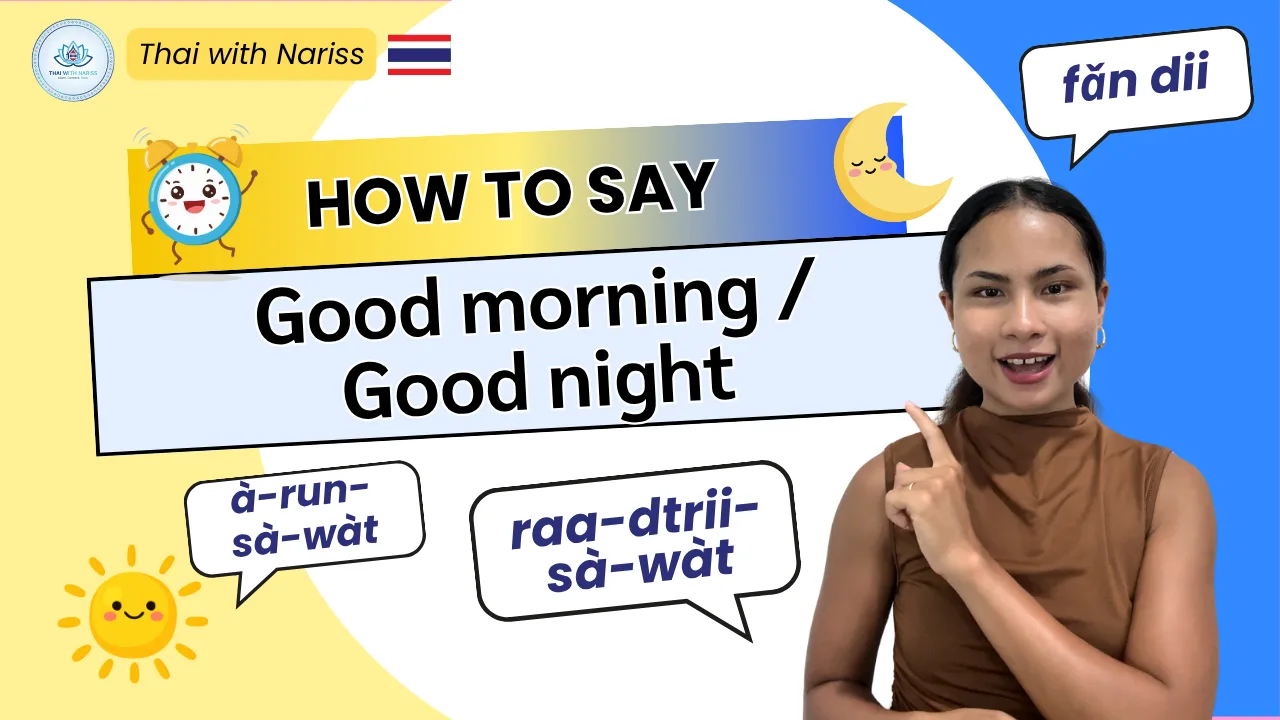
Good morning in Thai is arun sawat (อรุณสวัสดิ์) and good night is ratri sawat (ราตรีสวัสดิ์). For sweet dreams, say fan dee (ฝันดี). Here is the catch: Thais rarely say arun sawat out loud. The everyday greeting sawasdee covers every hour, while fan dee gets real use in goodnight texts.
Students ask me for these two phrases in their first lesson, usually because they want to message someone special in Thailand. So let me give you the textbook forms, then show you what Thais actually say in the morning and at bedtime, because the two lists barely overlap.
Arun Sawat: Good Morning in Thai
Arun sawat (อรุณสวัสดิ์), pronounced à-run-sà-wàt, is the formal good morning. Arun is an old word for dawn, so the phrase literally wishes someone a good daybreak. It is elegant, a little poetic, and you will hear it from morning news anchors and hotel staff far more often than from anyone's Thai friends.
| Thai | Pronunciation | English |
|---|---|---|
| อรุณสวัสดิ์ | à-run-sà-wàt | Good morning (formal) |
| สวัสดีตอนเช้า | sà-wàt-dii dtawn-cháo | Hello in the morning |
| นอนหลับสบายไหม | nawn làp sà-baai mái? | Did you sleep well? |
| นอนหลับฝันดีไหม | nawn làp fǎn-dii mái? | Did you sleep well? (lit. sleep with good dreams) |
อรุณสวัสดิ์
à-run-sà-wàt
Good morning (formal)
สวัสดีตอนเช้า
sà-wàt-dii dtawn-cháo
Hello in the morning
นอนหลับสบายไหม
nawn làp sà-baai mái?
Did you sleep well?
นอนหลับฝันดีไหม
nawn làp fǎn-dii mái?
Did you sleep well? (lit. sleep with good dreams)
Why Thais Rarely Say Good Morning
Thai does not split the day the way English does. Sawasdee works at 7am, at noon, and at midnight, so a separate morning greeting never became part of daily speech. Greet a street vendor with arun sawat and you will sound like a 1960s radio host: charming, but theatrical. What a Thai friend actually says in the morning is sawasdee, or simply "did you sleep well?"
If sawasdee is still new to you, start with my guide on how to say hello in Thai, then come back here. And for the wai, phone hellos, and goodbyes, the full picture is in my complete guide to Thai greetings.
Good Afternoon and Good Evening in Thai
The same logic applies after lunch. Sawasdee dtawn-bàai (good afternoon) and sawasdee dtawn-yen (good evening) exist, and TV presenters use them to open their programs. In conversation, Thais drop the time entirely. Learn to recognize these forms; do not feel obliged to produce them.
| Thai | Pronunciation | English |
|---|---|---|
| สวัสดีตอนบ่าย | sà-wàt-dii dtawn-bàai | Good afternoon (formal, announcements) |
| สวัสดีตอนเย็น | sà-wàt-dii dtawn-yen | Good evening (formal, announcements) |
สวัสดีตอนบ่าย
sà-wàt-dii dtawn-bàai
Good afternoon (formal, announcements)
สวัสดีตอนเย็น
sà-wàt-dii dtawn-yen
Good evening (formal, announcements)
Ratri Sawat: Good Night in Thai
Ratri sawat (ราตรีสวัสดิ์), pronounced raa-dtrii-sà-wàt, is the formal good night. Ratri is a literary word for night, borrowed from Sanskrit, which gives the phrase a romantic, storybook feel. Thais do use it, but mostly in writing: a goodnight message to someone they are courting, a caption under a moonlit photo.
| Thai | Pronunciation | English |
|---|---|---|
| ราตรีสวัสดิ์ | raa-dtrii-sà-wàt | Good night (formal, romantic in texts) |
ราตรีสวัสดิ์
raa-dtrii-sà-wàt
Good night (formal, romantic in texts)
Fan Dee: Sweet Dreams in Thai
Fan dee (ฝันดี) literally means "dream well", and this is the good night Thais actually say. It is warm without being heavy, so it works for your partner and for your Thai host family alike. The fuller version nawn làp fǎn dii adds "sleep well" in front, like saying sleep tight and sweet dreams in one breath.
| Thai | Pronunciation | English |
|---|---|---|
| ฝันดี | fǎn dii | Sweet dreams / Good night (everyday) |
| ฝันดีนะ | fǎn dii ná | Sweet dreams (warmer, with the soft ná) |
| นอนหลับฝันดี | nawn làp fǎn dii | Sleep well and sweet dreams |
| ฝันดีนะที่รัก | fǎn dii ná thîi-rák | Sweet dreams, my love |
ฝันดี
fǎn dii
Sweet dreams / Good night (everyday)
ฝันดีนะ
fǎn dii ná
Sweet dreams (warmer, with the soft ná)
นอนหลับฝันดี
nawn làp fǎn dii
Sleep well and sweet dreams
ฝันดีนะที่รัก
fǎn dii ná thîi-rák
Sweet dreams, my love
Khrap, Kha, and Na: Polishing Your Good Night
The gender particles work here the way they do everywhere in Thai: men add khráp, women add khà, following the speaker, never the listener. One subtlety worth knowing: after the softening particle ná, women switch from khà to a high-tone khá. So a woman writes fǎn dii ná khá, not fǎn dii ná khà. Thais will forgive the mix-up, but the correct version reads as noticeably more fluent.
| Thai | Pronunciation | English |
|---|---|---|
| ฝันดีครับ | fǎn dii khráp | Sweet dreams (male speaker, polite) |
| ฝันดีค่ะ | fǎn dii khà | Sweet dreams (female speaker, polite) |
| ฝันดีนะคะ | fǎn dii ná khá | Sweet dreams (female speaker, warm) |
ฝันดีครับ
fǎn dii khráp
Sweet dreams (male speaker, polite)
ฝันดีค่ะ
fǎn dii khà
Sweet dreams (female speaker, polite)
ฝันดีนะคะ
fǎn dii ná khá
Sweet dreams (female speaker, warm)
Texting Good Night vs Saying It
Most of the phrases in this article live on screens. A Thai goodnight text usually ends the chat with fǎn dii ná, often followed by a sticker doing half the emotional work. Couples reach for ratri sawat or fǎn dii ná thîi-rák when they want to be sweet. Younger Thais also type the English loan "gn" or กู๊ดไนท์, good night spelled in Thai letters.
Common Mistakes
The classic one is translating English habits directly: opening every morning conversation with arun sawat. Grammatically fine, socially starched. Sawasdee khráp or khà is what the moment calls for.
Watch the vowel in fǎn. It is short, like "fun" said quickly, with a rising tone. Stretch it into a long "faan" and the word stops meaning dream.
And do not say ratri sawat face to face as a routine good night. It reads beautifully in a message and sounds stiff in person, like wishing your roommate "a pleasant repose".
Practice
What would you say in each situation? Say it out loud, then check. Answers are for a female speaker; swap khà and khá for khráp if you are a man.
- Your Thai host mother heads to bed before you.
- Your friend looks tired at breakfast. Greet them anyway.
| Thai | Pronunciation | English |
|---|---|---|
| ฝันดีนะคะ | fǎn dii ná khá | 1. Sweet dreams (warm and polite) |
| สวัสดีค่ะ นอนหลับสบายไหม | sà-wàt-dii khà, nawn làp sà-baai mái? | 2. Morning! Did you sleep well? |
ฝันดีนะคะ
fǎn dii ná khá
1. Sweet dreams (warm and polite)
สวัสดีค่ะ นอนหลับสบายไหม
sà-wàt-dii khà, nawn làp sà-baai mái?
2. Morning! Did you sleep well?
These bedtime phrases sit alongside the 100+ basic Thai phrases I teach my students. And if you are packing for Thailand, my Thai for Travelers course covers the rest of the day too: ordering breakfast, taking taxis, and bargaining at the night market, with native audio throughout.