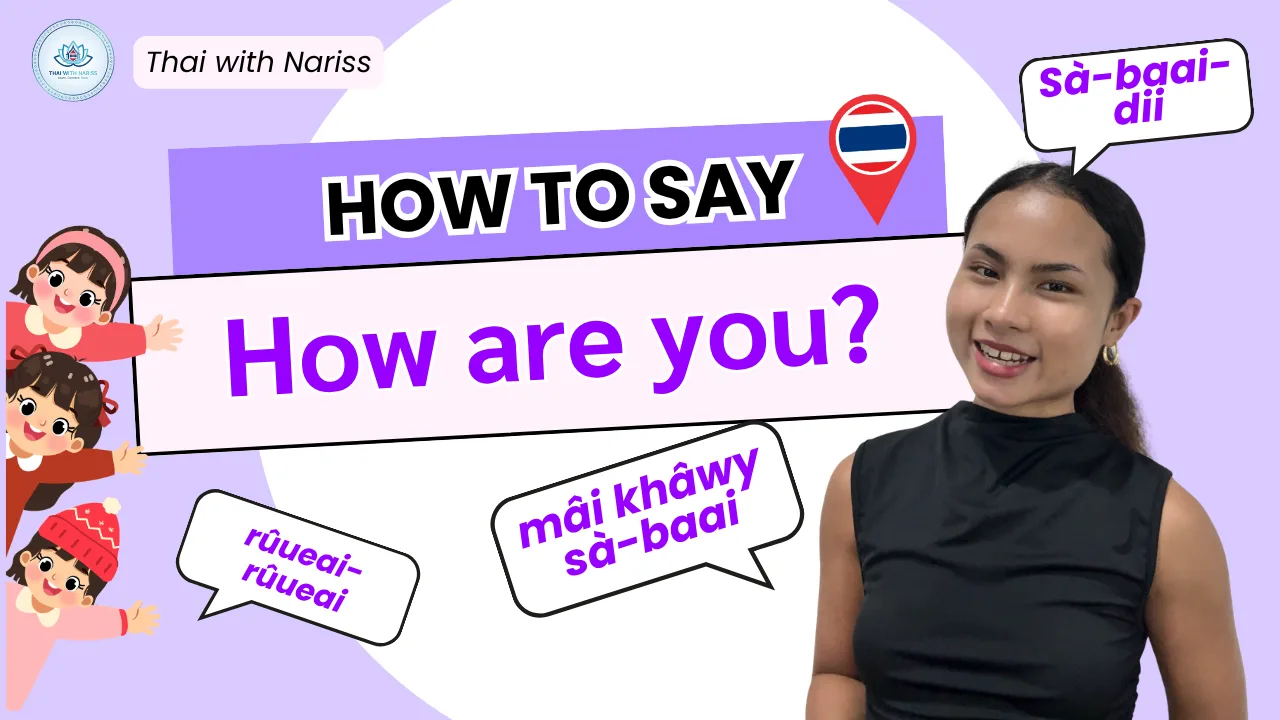
To ask how are you in Thai, say sabai dee mai (สบายดีไหม). The reply is sabai dee (สบายดี), I am fine, or mai sabai (ไม่สบาย) if you feel unwell. Men end the question with khrap, women with kha. Literally, the phrase asks whether you feel comfortable and well.
After saying hello in Thai, this is usually the second phrase my students want, because it turns a greeting into a conversation. The textbook version above is correct. What Thais do with it in real life is a little different, and that difference is worth five minutes of your time.
Sabai Dee Mai: How Are You in Thai
Sabai dee mai (สบายดีไหม), pronounced sà-baai dii mái?, is the standard how are you. The ending mái turns the statement "you are well" into a question. One detail women should know: after a question, the polite particle is khá with a high tone, not the usual khà. Men stay with khráp everywhere.
| Thai | Pronunciation | English |
|---|---|---|
| สบายดีไหมครับ | sà-baai dii mái khráp? | How are you? (male speaker) |
| สบายดีไหมคะ | sà-baai dii mái khá? | How are you? (female speaker) |
สบายดีไหมครับ
sà-baai dii mái khráp?
How are you? (male speaker)
สบายดีไหมคะ
sà-baai dii mái khá?
How are you? (female speaker)
How to Respond: Sabai Dee and Mai Sabai
I'm fine in Thai is sabai dee (สบายดี), the same words minus the question particle. Feeling under the weather? Mâi khâwy sà-baai, not so great, keeps it honest without drama, while mâi sà-baai on its own usually means you are properly sick. Thais often add a quick thanks after answering, so this pairs naturally with knowing how to say thank you in Thai.
| Thai | Pronunciation | English |
|---|---|---|
| สบายดีค่ะ | sà-baai dii khà | I'm fine (female speaker) |
| สบายดีครับ | sà-baai dii khráp | I'm fine (male speaker) |
| ไม่ค่อยสบาย | mâi khâwy sà-baai | Not feeling so great |
| ไม่สบาย | mâi sà-baai | I'm sick / unwell |
สบายดีค่ะ
sà-baai dii khà
I'm fine (female speaker)
สบายดีครับ
sà-baai dii khráp
I'm fine (male speaker)
ไม่ค่อยสบาย
mâi khâwy sà-baai
Not feeling so great
ไม่สบาย
mâi sà-baai
I'm sick / unwell
Sabai: The Word Doing All the Work
Sabai means comfortable, at ease, well in body and mind. It is one of the most Thai words there is. Doubled as sabai sabai, it describes the entire mood of a beach afternoon in Koh Samui: relaxed, no hurry, nothing wrong. So sà-baai dii mái asks something warmer than "how are you"; it asks whether life feels easy today. That is also why the answer is rarely a health report.
| Thai | Pronunciation | English |
|---|---|---|
| สบายๆ | sà-baai sà-baai | Easygoing, relaxed, no stress |
| ชิลล์ ชิลล์ | chiw-chiw | Chilling / to be chilled / relaxed |
สบายๆ
sà-baai sà-baai
Easygoing, relaxed, no stress
ชิลล์ ชิลล์
chiw-chiw
Chilling / to be chilled / relaxed
What Thais Actually Ask Instead
Here is the honest part: Thais do not open every chat with sà-baai dii mái. Between people who see each other daily, the real how-are-you is gin khâao rǔue yang, have you eaten yet, or bpai nǎi, where are you headed. Neither expects a detailed answer; both are warmth dressed up as questions. I cover the eating one properly, with its answers, in my guide to Thai greetings. Sà-baai dii mái tends to come out when some time has passed: a friend back from a trip, a neighbor you have not crossed paths with in a couple of weeks.
Bpen Yang Ngai Bang: The Casual Version
With friends, Thais often ask bpen yang-ngai bâang (เป็นยังไงบ้าง), how is it going, what is new. It invites a real answer, the flooded soi or the new puppy. A relaxed reply that fits almost any day is gâw rûueai-rûueai, same as usual.
| Thai | Pronunciation | English |
|---|---|---|
| เป็นยังไงบ้าง | bpen yang-ngai bâang | How's it going? (casual, friends) |
| เป็นไงบ้าง | bpen ngai bâang | How's it going? (shorter, casual) |
| ก็เรื่อยๆ | gâw rûueai-rûueai | Same as usual / Can't complain |
เป็นยังไงบ้าง
bpen yang-ngai bâang
How's it going? (casual, friends)
เป็นไงบ้าง
bpen ngai bâang
How's it going? (shorter, casual)
ก็เรื่อยๆ
gâw rûueai-rûueai
Same as usual / Can't complain
Asking Back: Laew Khun La
A how-are-you answered without a return question feels clipped in Thai, just as it does in English. The phrase you want is láew khun lâ, and you? Between friends, swap khun for the person's nickname; Thais use names where English uses "you", and it sounds instantly closer.
| Thai | Pronunciation | English |
|---|---|---|
| แล้วคุณล่ะ | láew khun lâ | And you? |
แล้วคุณล่ะ
láew khun lâ
And you?
Common Mistakes
The first mistake is frequency. English speakers deploy "how are you" as pure routine, several times a day, to everyone. Use sà-baai dii mái that way and it sounds oddly clinical, like asking after someone's recovery. Save it for people you have not seen in a while, and let gin khâao rǔue yang do the daily work.
The second is the two mais. The question particle mái (ไหม) rises; the negative mâi (ไม่) falls. Sà-baai dii mái asks; mâi sà-baai states. Mix the tones and the sentence quietly changes jobs.
The third is overexplaining. Asked how you are by the mango vendor, a full medical update is not expected. Sà-baai dii khà, a smile, done.
Practice
Your turn. What do you say in each spot? Answers use the female particles khà and khá; men say khráp in both places.
- A neighbor you last saw before your trip to Bangkok.
- She asks how you are. You are fine, and you ask back.
- Your Thai friend texts "bpen yang-ngai bâang?" Nothing special happened.
| Thai | Pronunciation | English |
|---|---|---|
| สบายดีไหมคะ | sà-baai dii mái khá? | 1. How are you? (it's been a while) |
| สบายดีค่ะ แล้วคุณล่ะคะ | sà-baai dii khà, láew khun lâ khá? | 2. I'm fine, and you? |
| ก็เรื่อยๆ | gâw rûueai-rûueai | 3. Same as usual |
สบายดีไหมคะ
sà-baai dii mái khá?
1. How are you? (it's been a while)
สบายดีค่ะ แล้วคุณล่ะคะ
sà-baai dii khà, láew khun lâ khá?
2. I'm fine, and you?
ก็เรื่อยๆ
gâw rûueai-rûueai
3. Same as usual
Three small words, and suddenly the conversation is yours to lose. If you want to follow the answer too, not just trigger it, my Thai for Travelers course trains your ear with short native-speed dialogues, the kind of Thai you actually hear back on the street.