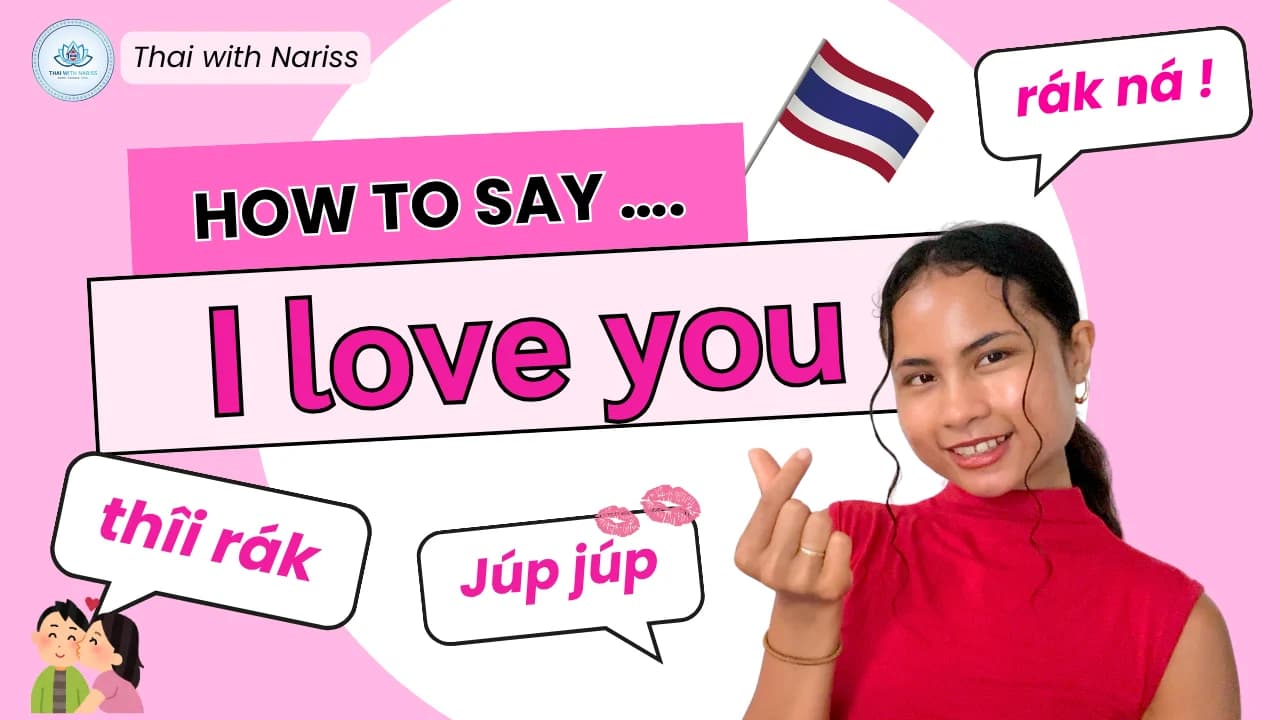
To say I love you in Thai, a woman says chán rák khun (ฉันรักคุณ) and a man says phǒm rák khun (ผมรักคุณ). The pronoun follows the speaker. The word for love, rák (รัก), never changes. Between couples, the short rák ná (รักนะ) is what you will actually hear and text.
This guide follows five stages of a relationship, from the first spark to married life, with the Thai script, romanization, and notes on who uses what. You can also browse the Thai phrases library for more vocabulary organized by topic.
Stage 1 - The Spark: Saying You Like Someone
Thai distinguishes between รัก (rák), which means love, and ชอบ (châwp), which means like. When feelings are new and you are not ready to declare love, ชอบ is the word to reach for.
Note: Thai has gendered first-person pronouns. Women use ฉัน (chán) and men use ผม (phǒm) in polite speech. The second-person pronoun also shifts: คุณ (khun) is more formal, เธอ (ter) more casual.
I like you
| Thai | Pronunciation | English |
|---|---|---|
| ฉันชอบคุณ | Chán châwp khun | I like you.Formal, female speaker |
| ผมชอบเธอ | Phǒm châwp ter | I like you.Casual, male speaker |
| ฉันชอบคุณนะ | chán châwp khun ná | I like you, you know.The particle นะ softens the statement, makes it warmer |
| ผมชอบเธอมากเลย | phǒm châwp ter mâak loei | I really like you!Casual, male speaker. มากเลย adds emphasis |
ฉันชอบคุณ
Chán châwp khun
I like you.
Formal, female speaker
ผมชอบเธอ
Phǒm châwp ter
I like you.
Casual, male speaker
ฉันชอบคุณนะ
chán châwp khun ná
I like you, you know.
The particle นะ softens the statement, makes it warmer
ผมชอบเธอมากเลย
phǒm châwp ter mâak loei
I really like you!
Casual, male speaker. มากเลย adds emphasis
Stage 2 - Falling: When Like Becomes Love
There is a delightful Thai idiom for falling in love: ตกหลุมรัก (dtòk-lǔm-rák), literally "to fall into the pit of love." It captures that helpless, tumbling feeling perfectly.
Falling in love
| Thai | Pronunciation | English |
|---|---|---|
| ผมตกหลุมรักคุณแล้ว | Phǒm dtòk-lǔm-rák khun láew | I've fallen in love with you.Male speaker. แล้ว signals that something has already happened |
ผมตกหลุมรักคุณแล้ว
Phǒm dtòk-lǔm-rák khun láew
I've fallen in love with you.
Male speaker. แล้ว signals that something has already happened
Stage 3 - Commitment: Saying I Love You
When you are ready to say those three words, ผมรักคุณ (phǒm rák khun) or ฉันรักคุณ (chán rák khun) is the standard phrase. Thai couples also have their own shorthand. รักนะ (rák ná) is the quick, affectionate version you text a hundred times a day.
I love you
| Thai | Pronunciation | English |
|---|---|---|
| ผมรักคุณ | phǒm rák khun | I love you.Male speaker, standard form |
| ฉันรักคุณที่สุดในโลก | chán rák khun thîi-sùt nai lôk | I love you the most in the world.Female speaker. ที่สุด means the most |
| รักนะ | rák ná | Love ya!Casual, gender-neutral shorthand used in texts |
| จุ๊บๆ | júp-júp | Muah!Playful sound of a kiss, used in messages |
ผมรักคุณ
phǒm rák khun
I love you.
Male speaker, standard form
ฉันรักคุณที่สุดในโลก
chán rák khun thîi-sùt nai lôk
I love you the most in the world.
Female speaker. ที่สุด means the most
รักนะ
rák ná
Love ya!
Casual, gender-neutral shorthand used in texts
จุ๊บๆ
júp-júp
Muah!
Playful sound of a kiss, used in messages
When your partner says รักนะ (rák ná), the natural reply is:
| Thai | Pronunciation | English |
|---|---|---|
| ฉันก็รักคุณเหมือนกัน | chán gâw rák khun mǔuean gan | I love you too. |
ฉันก็รักคุณเหมือนกัน
chán gâw rák khun mǔuean gan
I love you too.
Stage 4 - Marriage: The Proposal
Ready to take the next step? Thai proposals range from the casual and gentle to the fully formal question. The particle นะ at the end of the first option makes it feel like an invitation rather than a demand.
Will you marry me?
| Thai | Pronunciation | English |
|---|---|---|
| แต่งงานกับผมนะ | dtàng-ngaan gàp phǒm ná | Marry me, okay?Gentle, affectionate tone |
| คุณจะแต่งงานกับผมไหม | khun jà dtàng-ngaan gàp phǒm mái? | Will you marry me?More formal question form |
แต่งงานกับผมนะ
dtàng-ngaan gàp phǒm ná
Marry me, okay?
Gentle, affectionate tone
คุณจะแต่งงานกับผมไหม
khun jà dtàng-ngaan gàp phǒm mái?
Will you marry me?
More formal question form
Stage 5 - Married Life: Talking About Your Spouse
Thai has both formal and casual words for husband and wife. The casual versions, ผัว (pǔua) and เมีย (miia), are common in everyday speech among Thai couples. You might hear them used affectionately, or even teasingly.
Husband and wife vocabulary
| Thai | Pronunciation | English |
|---|---|---|
| ภรรยา | pan-ra-yaa | WifeFormal |
| เมีย | miia | WifeCasual, commonly used between couples |
| สามี | sǎa-mii | HusbandFormal |
| ผัว | pǔua | HusbandCasual, commonly used between couples |
| ที่รัก | thîi-rák | My dear / My loveUsed as a term of address for a spouse or partner |
| รักเมียที่สุด | rák miia thîi-sùt | Love my wife the most. |
| รักสามีที่สุด | rák sǎa-mii thîi-sùt | Love my husband the most. |
ภรรยา
pan-ra-yaa
Wife
Formal
เมีย
miia
Wife
Casual, commonly used between couples
สามี
sǎa-mii
Husband
Formal
ผัว
pǔua
Husband
Casual, commonly used between couples
ที่รัก
thîi-rák
My dear / My love
Used as a term of address for a spouse or partner
รักเมียที่สุด
rák miia thîi-sùt
Love my wife the most.
รักสามีที่สุด
rák sǎa-mii thîi-sùt
Love my husband the most.
Teerak, Faen, Tua-Eng: Thai Terms of Endearment
Thai couples rarely call each other by name at home. The everyday term of address is ที่รัก (thîi-rák), "my love", which you met in the table above. Just as common is ตัวเอง (dtua-eeng, often written tua-eng in chat), literally "yourself", which works roughly like "babe". And แฟน (faen) covers boyfriend, girlfriend, and partner in one gender-neutral word, which makes it one of the most useful words in this whole article.
Sweet ways to address your partner
| Thai | Pronunciation | English |
|---|---|---|
| ที่รัก | thîi-rák | My love / DarlingThe classic term of address between partners |
| ตัวเอง | dtua-eeng | BabeLiterally: yourself. Very common between couples |
| คนดี | khon dii | SweetheartLiterally: good person. Tender and warm |
| แฟน | faen | Boyfriend / Girlfriend / PartnerGender-neutral |
| คุณมีแฟนหรือยัง | khun mii faen rǔue yang? | Do you have a partner yet?A question you will hear early and often in Thailand |
ที่รัก
thîi-rák
My love / Darling
The classic term of address between partners
ตัวเอง
dtua-eeng
Babe
Literally: yourself. Very common between couples
คนดี
khon dii
Sweetheart
Literally: good person. Tender and warm
แฟน
faen
Boyfriend / Girlfriend / Partner
Gender-neutral
คุณมีแฟนหรือยัง
khun mii faen rǔue yang?
Do you have a partner yet?
A question you will hear early and often in Thailand
Cultural Notes on Love in Thailand
Love in Isan: a different word
In northeastern Thailand (Isan), the word for love is ฮัก (hák) rather than the central Thai รัก (rák). If you are spending time in Khon Kaen, Udon Thani, or anywhere in the region, you will hear this version. Both words carry the same warmth.
Gestures of affection in Thai culture
Thai expressions of love are not always spoken. The wai, ไหว้ (wâi), the same palms-together gesture that accompanies a heartfelt thank you in Thai, carries emotional weight depending on context. Gifts and gestures often say more than words in Thai culture.
A Thai proverb about love
Thai has a beautiful idiom that captures a very practical wisdom about relationships:
| Thai | Pronunciation | English |
|---|---|---|
| รักยาวให้บั่น รักสั้นให้ต่อ | Rák yaao hâi bàn, rák sân hâi dtàw | Love long, cut it short; love short, extend it.Meaning: keep long relationships concise and focused; nurture short ones to help them grow |
รักยาวให้บั่น รักสั้นให้ต่อ
Rák yaao hâi bàn, rák sân hâi dtàw
Love long, cut it short; love short, extend it.
Meaning: keep long relationships concise and focused; nurture short ones to help them grow
Love in Thai music
One of the most beloved love songs in Thai pop is รักเธอหมดใจ (Rák ter mòt jai), meaning "Love you all my heart," by the band Potato. It is a great song to listen to while you practice these phrases. Thai music is one of the best ways to absorb vocabulary in context.
Curious how learning love vocabulary compares to learning other emotional expressions? The article on how to say miss in Thai covers another emotionally rich area of the language with nine distinct words.
Frequently Asked Questions
How do you say I love you in Thai?
The standard phrase is ผมรักคุณ (phǒm rák khun) for male speakers and ฉันรักคุณ (chán rák khun) for female speakers. In casual everyday use, couples often shorten it to รักนะ (rák ná), which is the equivalent of "love ya."
What is the difference between รัก and ชอบ?
รัก (rák) means love, and ชอบ (châwp) means like. Thai speakers use ชอบ when expressing early romantic interest or casual fondness, and รัก when the feeling is deeper and more committed. Using รัก too early can feel intense, just as it would in English.
Is รัก used for all kinds of love?
Yes. รัก covers romantic love, family love, and deep friendship. Context makes the meaning clear. You would say ฉันรักแม่ (chán rák mâe, I love my mother) and ฉันรักเธอ (chán rák ter, I love you, to a partner) using the same word.
How do Thais say I love you in text messages?
The most common shorthand is รักนะ (rák ná) or just รัก. You will also see จุ๊บๆ (júp-júp) for kiss sounds, and ที่รัก (thîi-rák) as a greeting meaning "my love" or "my dear."
What does ตกหลุมรัก mean?
ตกหลุมรัก (dtòk-lǔm-rák) literally means "to fall into the pit of love." It is the Thai equivalent of "falling in love" and carries the same sense of something that happens to you rather than something you choose.
Common Mistakes
The first mistake is reaching for รัก too early. In Thai, as in English, declaring love on the second date feels intense. Stay with ชอบ (châwp) until the feeling has earned the bigger word.
The second is copying your partner's pronoun. If your girlfriend says ฉันรักคุณ (chán rák khun), your reply starts with ผม (phǒm), not ฉัน (chán), because the first-person pronoun follows the speaker's gender. I correct this one in lessons every month.
Third, the tone. รัก (rák) is a high tone, with the voice lifted. Said flat, it still gets through in context, but the lift is what makes it sound like Thai instead of a transcription. Listen to รักนะ (rák ná) in any Thai drama and copy the curve.
And keep ผัว (pǔua) and เมีย (miia) inside the relationship. Between partners they are affectionate; describing someone else's spouse with them in polite company sounds blunt. Use สามี (sǎa-mii) and ภรรยา (pan-ra-yaa) there.
Practice
How would you handle each situation below? Say it out loud, then check the answers. Answers are for a female speaker; swap ฉัน (chán) for ผม (phǒm) if you are a man.
- Send your partner a quick "love you" text.
- Call your partner.
- Your partner just said รักนะ (rák ná). Reply.
| Thai | Pronunciation | English |
|---|---|---|
| รักนะ | rák ná | Love ya! (texting shorthand) |
| ที่รัก | thîi-rák | My love |
| ฉันก็รักคุณเหมือนกัน | chán gâw rák khun mǔuean gan | I love you too |
รักนะ
rák ná
Love ya! (texting shorthand)
ที่รัก
thîi-rák
My love
ฉันก็รักคุณเหมือนกัน
chán gâw rák khun mǔuean gan
I love you too
Quick Reference: Essential Love Phrases
| Thai | Pronunciation | English |
|---|---|---|
| ชอบ | châwp | to like |
| รัก | rák | to love |
| ฉันชอบคุณ | Chán châwp khun | I like you (formal, female speaker) |
| ผมชอบเธอ | Phǒm châwp ter | I like you (casual, male speaker) |
| ผมตกหลุมรักคุณแล้ว | Phǒm dtòk-lǔm-rák khun láew | I've fallen in love with you |
| ผมรักคุณ | phǒm rák khun | I love you (male speaker) |
| รักนะ | rák ná | Love ya! |
| ฉันก็รักคุณเหมือนกัน | chán gâw rák khun mǔuean gan | I love you too |
| แต่งงานกับผมนะ | dtàng-ngaan gàp phǒm ná | Marry me, okay? |
| ที่รัก | thîi-rák | My dear / My love |
ชอบ
châwp
to like
รัก
rák
to love
ฉันชอบคุณ
Chán châwp khun
I like you (formal, female speaker)
ผมชอบเธอ
Phǒm châwp ter
I like you (casual, male speaker)
ผมตกหลุมรักคุณแล้ว
Phǒm dtòk-lǔm-rák khun láew
I've fallen in love with you
ผมรักคุณ
phǒm rák khun
I love you (male speaker)
รักนะ
rák ná
Love ya!
ฉันก็รักคุณเหมือนกัน
chán gâw rák khun mǔuean gan
I love you too
แต่งงานกับผมนะ
dtàng-ngaan gàp phǒm ná
Marry me, okay?
ที่รัก
thîi-rák
My dear / My love
Want to practice these phrases with a real conversation? A private lesson with Nariss is the fastest way to build confidence speaking Thai with someone who actually cares whether you get it right. Book a free consultation to find out which course fits your level and goals.