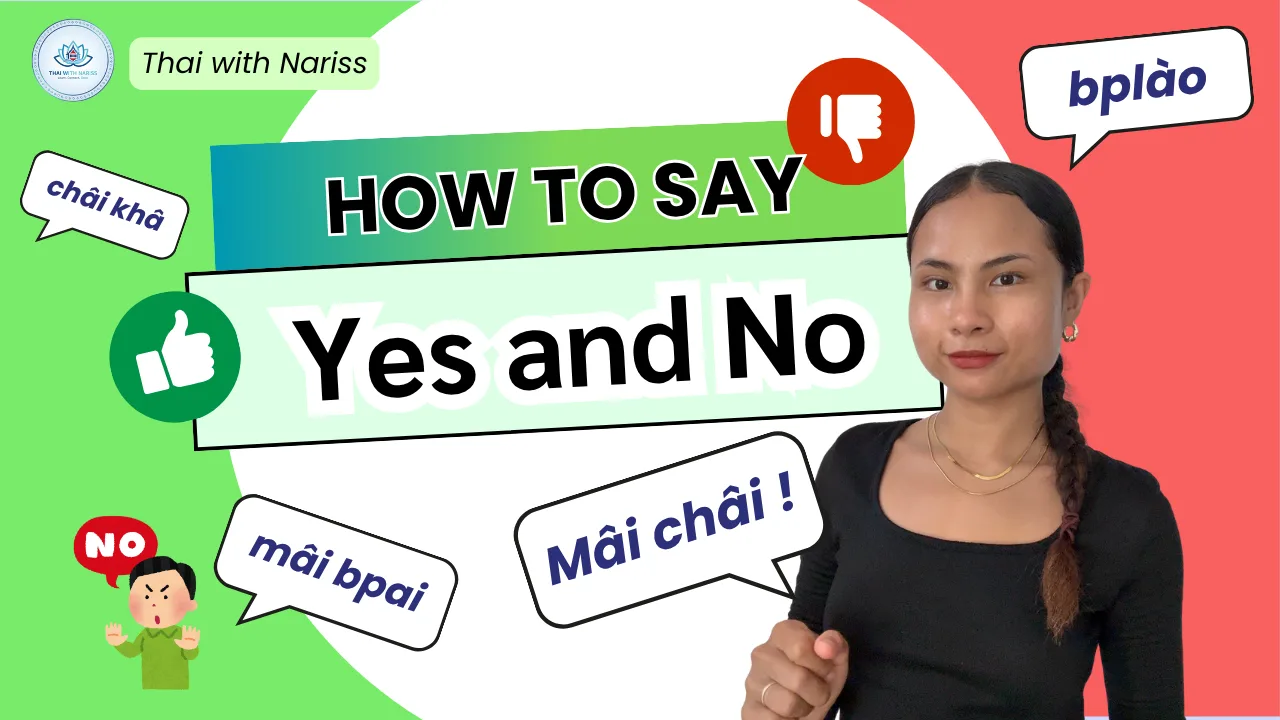
To say yes in Thai, say chai (ใช่); for no, say mai chai (ไม่ใช่). Strictly speaking, though, Thai has no exact words for yes and no. Most of the time you answer a question by repeating its verb or negating that verb with mai, and the polite khrap or kha can carry a yes on its own.
This catches every learner at some point, usually at a market stall when a vendor fires off a question and "chai" gets a confused look back. If you are still mapping out the basics, my beginner's guide on how to learn Thai explains the big picture. Here, we fix yes and no for good.
Video
Chai: The Thai Word for Yes (Sort Of)
Chai (ใช่), pronounced châi with a falling tone, means "that is correct" rather than a universal yes. Use it to confirm a fact or an identity: yes, I am John; yes, this is the bus to Chaweng. Add the polite particle that matches your own gender, khráp for men and khà for women.
| Thai | Pronunciation | English |
|---|---|---|
| ใช่ครับ | châi khráp | Yes, that's right (male speaker) |
| ใช่ค่ะ | châi khà | Yes, that's right (female speaker) |
| ใช่ | châi | Yes / Correct (plain, between friends) |
| ใช่ๆ | châi châi | Yes, that is absolutely correct! |
ใช่ครับ
châi khráp
Yes, that's right (male speaker)
ใช่ค่ะ
châi khà
Yes, that's right (female speaker)
ใช่
châi
Yes / Correct (plain, between friends)
ใช่ๆ
châi châi
Yes, that is absolutely correct!
Mai Chai: How to Say No in Thai
Mai chai (ไม่ใช่), pronounced mâi châi, is the matching no: "that is not correct". It politely rejects a wrong assumption. Someone guesses you are Russian and you are not? Mâi châi khráp. The taxi driver points at a hotel that is not yours? Mâi châi khà. Again, the particle softens it and follows your gender, not the listener's.
| Thai | Pronunciation | English |
|---|---|---|
| ไม่ใช่ครับ | mâi châi khráp | No, that's not right (male speaker) |
| ไม่ใช่ค่ะ | mâi châi khà | No, that's not right (female speaker) |
ไม่ใช่ครับ
mâi châi khráp
No, that's not right (male speaker)
ไม่ใช่ค่ะ
mâi châi khà
No, that's not right (female speaker)
The Real Pattern: Answer with the Verb
Here is the part textbooks bury. A Thai yes/no question usually ends in mái (ไหม), and the natural answer is not chai or mai chai. It is the verb itself. Asked bpai mái, are you going, you answer bpai for yes or mâi bpai for no. The question hands you the verb; you hand it back, plain for yes, with mâi in front for no.
| Thai | Pronunciation | English |
|---|---|---|
| ไปไหม | bpai mái? | Are you going? |
| ไป | bpai | Yes (literally: go) |
| ไม่ไป | mâi bpai | No (literally: not go) |
| เอาไหม | ao mái? | Do you want it? |
| เอา / ไม่เอา | ao / mâi ao | Yes, I'll take it / No, I don't want it |
ไปไหม
bpai mái?
Are you going?
ไป
bpai
Yes (literally: go)
ไม่ไป
mâi bpai
No (literally: not go)
เอาไหม
ao mái?
Do you want it?
เอา / ไม่เอา
ao / mâi ao
Yes, I'll take it / No, I don't want it
This one pattern covers hundreds of everyday exchanges, and you can see it running through the question-and-answer pairs in my guide to basic Thai phrases. Learn the verb, and both answers come free.
Khrap and Kha: The Quiet Yes
Listen to two Thais on the phone and you will hear a stream of khráp khráp khráp or khà khà khà. The polite particles work as a soft yes: agreement, acknowledgement, "I am listening". When a receptionist asks if you want a taxi at 9, a simple khráp or khà with a nod answers the question completely. It is the gentlest yes in the language, and Thais use it far more than chai. A male speaker can also firm it up to ครับผม (kháp phǒm), a crisp "yes, sir / yes, ma'am" that adds respect.
| Thai | Pronunciation | English |
|---|---|---|
| ครับผม | kháp phǒm | Yes, sir / Yes, ma'am (male speaker) |
ครับผม
kháp phǒm
Yes, sir / Yes, ma'am (male speaker)
Chai Loei, Mai Chai Rawk: Shades of Yes and No
Once the basics sit comfortably, a few flavored versions take you off the textbook page. Loei (เลย) turns an agreement enthusiastic, the way "exactly!" does in English. For a no, ràwk (หรอก) or na (นะ) takes the sting out.
| Thai | Pronunciation | English |
|---|---|---|
| ใช่เลย | châi loei | Exactly! / That's so true |
| ไม่ใช่หรอก | mâi châi ràwk | Not really / No, it's not like that (softened) |
| ไม่ใช่นะ | mâi châi ná | No, that's not it (gentle correction) |
ใช่เลย
châi loei
Exactly! / That's so true
ไม่ใช่หรอก
mâi châi ràwk
Not really / No, it's not like that (softened)
ไม่ใช่นะ
mâi châi ná
No, that's not it (gentle correction)
Chai Mai, Ruue Bplao: Question Endings to Recognize
Two more endings decide which answer fits. Châi mái (ใช่ไหม) tacked onto a statement means "right?", and because the question itself contains chai, answering châi or mâi châi is exactly correct here. Rǔue bplào (หรือเปล่า) means "or not?" and asks for a straight answer: the verb for yes, or bplào for "nope, not the case".
| Thai | Pronunciation | English |
|---|---|---|
| คุณเป็นคนอังกฤษใช่ไหม | khun bpen khon ang-grìt châi mái? | You're English, right? |
| หิวหรือเปล่า | hǐu rǔue bplào | Are you hungry or not? |
| เปล่า | bplào | No, not really (neutral, no drama) |
คุณเป็นคนอังกฤษใช่ไหม
khun bpen khon ang-grìt châi mái?
You're English, right?
หิวหรือเปล่า
hǐu rǔue bplào
Are you hungry or not?
เปล่า
bplào
No, not really (neutral, no drama)
Common Mistakes
Mistake one: answering châi to everything. Asked ao mái, do you want it, châi sounds off because nothing was stated to be correct. Echo the verb instead: ao, or mâi ao.
Mistake two: a bare mâi as "no". On its own, mâi is a negator looking for a verb, like answering "not" in English. Attach it to the verb from the question, or use mâi ao for offers and mâi châi for wrong guesses. And to refuse something you cannot do, Thai has a dedicated pattern I cover in how to say cannot in Thai.
Mistake three: the tone on chai. Yes is châi, falling. With a high tone, chái (ใช้) means "to use", a different word entirely. Let the syllable drop like a sigh and you are safe.
Practice
Three quick situations. Decide whether the answer needs châi, the echoed verb, or bplào, then check below. Answers use khà; men swap in khráp.
- A vendor asks "ao prík mái?" (want chili?). You definitely do not.
- A new friend asks "khun bpen khon a-mee-rí-gan châi mái?" You are not American.
- Your teacher asks "khâo-jai mái?" (understand?). You do.
| Thai | Pronunciation | English |
|---|---|---|
| ไม่เอาค่ะ | mâi ao khà | 1. No thanks, I don't want it |
| ไม่ใช่ค่ะ | mâi châi khà | 2. No, that's not right |
| เข้าใจค่ะ | khâo-jai khà | 3. Yes, I understand (echoed verb) |
ไม่เอาค่ะ
mâi ao khà
1. No thanks, I don't want it
ไม่ใช่ค่ะ
mâi châi khà
2. No, that's not right
เข้าใจค่ะ
khâo-jai khà
3. Yes, I understand (echoed verb)
Once the echo-the-verb reflex clicks, Thai questions stop feeling like a trap. Building that reflex is what my Speaking Thai A1 course is for: 23 lessons that train question-and-answer patterns step by step, with quizzes after every one so the grammar becomes muscle memory.