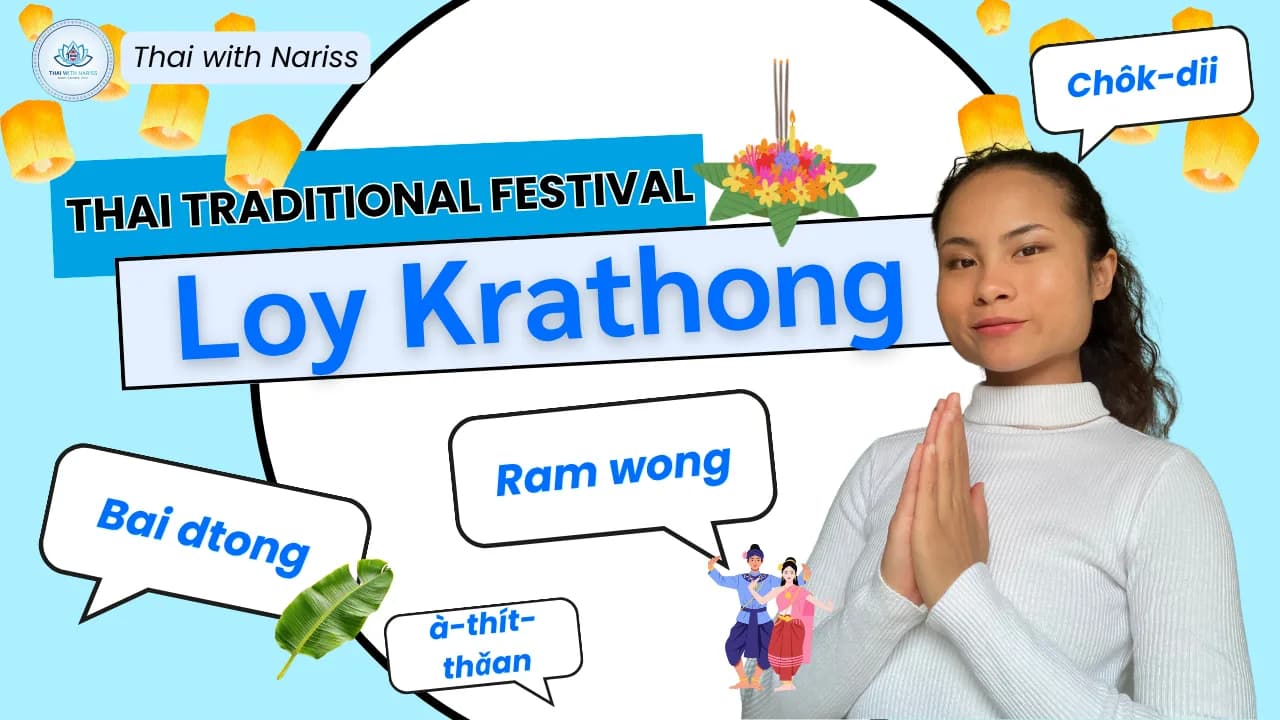
Loy Krathong is Thailand's festival of light on water, held on the full moon night of the twelfth Thai lunar month, usually in November. The name says it: loy (ลอย) means to float, and a krathong (กระทง, grà-thong) is a small decorated basket. You light its candle, make a wish, and set it on the river.
It is one of the two festivals visitors always ask me about. The other is Songkran, the water-throwing new year in April. Loy Krathong is the quiet one. Nobody gets soaked. You stand by the water after dark and watch thousands of candles drift downstream.
What Loy Krathong Is
Loy Krathong happens once a year, on the night of the full moon in the twelfth month of the old Thai lunar calendar. In 2026 that falls on the evening of November 24th. The date moves around the Western calendar because it follows the moon, so it is worth checking the year you travel.
After sunset people walk down to any water they can reach: a river, a lake, a hotel pond. The best spot is one that is easy to clean up the next day, which is why the beach is not a good place for it. They kneel at the edge, light the candle and the incense on their little basket, hold it for a second while they think of a wish, and let it go. Multiply that by a whole town and you get the sight that makes the festival famous. A river carrying hundreds of small flames, all moving the same direction, the reflections doubling every candle.
Living on Koh Samui, this was the one night of the year I looked forward to, and it is still my favorite Thai festival, which probably tells you something about how I ended up teaching this language. Every province does it.
What Goes Into a Krathong
The classic krathong (กระทง grà-thong) starts with a slice of banana tree trunk as its base, because the trunk is spongy and floats well. Around and on top of that go folded banana leaves, pinned into neat points, then fresh flowers, a candle, and usually three incense sticks. Most people also tuck in a coin.
The coin has a practical afterlife. Children wade in the next morning to collect the money from the floated baskets, so it doubles as a small act of giving. Some people also cut a few nail clippings or the tip of a lock of hair and add them to the basket. That part is symbolic: you are placing a piece of yourself on the water so the bad things of the past year go with the river.
| Thai | Pronunciation | English |
|---|---|---|
| กระทง | grà-thong | the floating basket itself |
| ต้นกล้วย | dtôn glûay | banana tree (its trunk is the base) |
| ใบตอง | bai dtong | banana leaf |
| ดอกไม้ | dòk-máai | flowers |
| เทียน | thian | candle |
| ธูป | thûup | incense stick |
| เหรียญ | rǐan | coin |
กระทง
grà-thong
the floating basket itself
ต้นกล้วย
dtôn glûay
banana tree (its trunk is the base)
ใบตอง
bai dtong
banana leaf
ดอกไม้
dòk-máai
flowers
เทียน
thian
candle
ธูป
thûup
incense stick
เหรียญ
rǐan
coin
You do not have to make your own, and most visitors do not. Sellers set up stalls near every floating spot in the days before, and a hand-made krathong costs very little.
Why Thais Float Krathongs
The festival is addressed to Phra Mae Khongkha (พระแม่คงคา phrá-mâae-khong-khaa), the goddess of water. Her name comes from Ganga, the Hindu goddess of the Ganges, and over the centuries she became the spirit Thais picture in every river and canal. Floating a krathong is two things at once. It is a thank-you for the water that grows the rice and fills the wells, and it is an apology, because we also pollute that same water and waste it all year. The candle carries both messages out onto the river.
There is a personal layer on top of the religious one. As the basket drifts out of reach, you are meant to let go of your grudges and whatever went wrong this year. People take it seriously. I have watched friends go very quiet at the water's edge, and I have done it myself.
You will often hear that the festival began with a court lady named Nang Noppamas (นางนพมาศ Naang Nóp-phá-mâat), who is said to have made the first lotus-shaped float for a Sukhothai king around seven hundred years ago. It is a lovely story and Thai children still learn it. Historians are not convinced. The text she appears in was most likely written in the early 1800s, during the Bangkok period, and there is no solid evidence she ever existed. Scholars such as Pasuk Phongpaichit and Chris Baker argue the tale was written to give a festival with older Khmer and Brahmin roots a neatly Thai origin. So enjoy the legend, but hold it a little loosely.
Loy Krathong Is Not Yi Peng
This one trips up almost everyone planning a trip. The photos you have seen of a black sky filled with glowing paper lanterns are usually Yi Peng, not Loy Krathong. They are different festivals that happen to fall on the same nights.
Yi Peng belongs to the north, to the old Lanna kingdom, and Chiang Mai is its home. Its lanterns are khom loy (โคมลอย), paper balloons lifted by a small flame, released upward into the sky. Loy Krathong sends its light the other way, down onto the water, and it happens all over the country. In Chiang Mai the two run together, which is why the images get mixed up. If your heart is set on the sky-lantern scene, you want Chiang Mai specifically, and you should look into the ticketed events, because the mass releases are organized and not a free-for-all.
The Song Everyone Sings
Every Thai person my age and younger grew up with one song, and it plays on a loop everywhere during the festival. Ask any Thai to start it and they will, without thinking. Here it is:
| Thai | Pronunciation | English |
|---|---|---|
| วันเพ็ญเดือนสิบสอง | wan-phen duean sìp-sǒng | On the full moon of the twelfth month |
| น้ำก็นองเต็มตลิ่ง | náam gôr nong dtem dtà-lìng | the water brims right up the banks |
| เราทั้งหลายชายหญิง | rao táng lǎai chaai yǐng | all of us, women and men |
| สนุกกันจริง วันลอยกระทง | sà-nùk gan jing wan loy grà-thong | have such fun on Loy Krathong day |
| ลอย ลอยกระทง | loy loy grà-thong | Loy Loy Krathong |
| ลอย ลอยกระทง | loy loy grà-thong | Loy Loy Krathong |
| ลอยกระทงกันแล้ว | loy grà-thong gan láew | Once we finished Loy Krathong |
| ขอเชิญน้องแก้ว ออกมารำวง | khǎw-chern nóng Gáew àwk maa ram wong | I invite you, my dear, to come out and dance the Ramwong |
| รำวงวันลอยกระทง | ram wong wan loy grà-thong | Dance the Ramwong on Loy Krathong day |
| รำวงวันลอยกระทง | ram wong wan loy grà-thong | Dance the Ramwong on Loy Krathong day |
| บุญจะส่งให้เราสุขใจ | bun jà sòng hâi rao sùk-jai | The merit will bring us happiness |
| บุญจะส่งให้เราสุขใจ | bun jà sòng hâi rao sùk-jai | The merit will bring us happiness |
วันเพ็ญเดือนสิบสอง
wan-phen duean sìp-sǒng
On the full moon of the twelfth month
น้ำก็นองเต็มตลิ่ง
náam gôr nong dtem dtà-lìng
the water brims right up the banks
เราทั้งหลายชายหญิง
rao táng lǎai chaai yǐng
all of us, women and men
สนุกกันจริง วันลอยกระทง
sà-nùk gan jing wan loy grà-thong
have such fun on Loy Krathong day
ลอย ลอยกระทง
loy loy grà-thong
Loy Loy Krathong
ลอย ลอยกระทง
loy loy grà-thong
Loy Loy Krathong
ลอยกระทงกันแล้ว
loy grà-thong gan láew
Once we finished Loy Krathong
ขอเชิญน้องแก้ว ออกมารำวง
khǎw-chern nóng Gáew àwk maa ram wong
I invite you, my dear, to come out and dance the Ramwong
รำวงวันลอยกระทง
ram wong wan loy grà-thong
Dance the Ramwong on Loy Krathong day
รำวงวันลอยกระทง
ram wong wan loy grà-thong
Dance the Ramwong on Loy Krathong day
บุญจะส่งให้เราสุขใจ
bun jà sòng hâi rao sùk-jai
The merit will bring us happiness
บุญจะส่งให้เราสุขใจ
bun jà sòng hâi rao sùk-jai
The merit will bring us happiness
Halfway through, the song turns into an invitation to dance the ram wong, the gentle circular Thai folk dance, and by the second chorus half the riverbank is doing it. If you learn just the first four lines, you will be able to hum along with everyone around you, and that alone earns you a lot of smiles.
Floating Yours
Here is how to do it if you are there. Find a seller near the water and buy a krathong. Point at the one you like and you are set. Take it to the edge, crouch down, and light the candle and the incense with the lighter the sellers usually keep on hand. Hold the basket in both hands for a moment, close your eyes, and make your wish. The Thai word for that quiet wish is à-thít-thǎan (อธิษฐาน). Then lower the krathong onto the water and give it a soft push. Do not throw it. Watch it go.
A few phrases make the whole thing smoother, and they double as a warm greeting to anyone nearby.
| Thai | Pronunciation | English |
|---|---|---|
| ขอซื้อกระทงหนึ่งอันครับ / ค่ะ | khǎw súe grà-thong nùeng an khráp / khà | I'd like to buy one krathong (male / female speaker) |
| อันนี้เท่าไหร่คะ | an-níi thâo-rài khá | How much is this one? (female asking) |
| สุขสันต์วันลอยกระทง | sùk-sǎn wan loy grà-thong | Happy Loy Krathong |
| ขอให้สมหวัง | khǎw hâi sǒm-wǎng | May your wish come true |
ขอซื้อกระทงหนึ่งอันครับ / ค่ะ
khǎw súe grà-thong nùeng an khráp / khà
I'd like to buy one krathong (male / female speaker)
อันนี้เท่าไหร่คะ
an-níi thâo-rài khá
How much is this one? (female asking)
สุขสันต์วันลอยกระทง
sùk-sǎn wan loy grà-thong
Happy Loy Krathong
ขอให้สมหวัง
khǎw hâi sǒm-wǎng
May your wish come true
Remember the particle follows you, not the person you are speaking to: a man ends with khráp ครับ, a woman with khà ค่ะ when stating something and khá คะ when asking. The seller will answer your price question with a number, so it helps to know how Thai numbers and prices work before you go. Say sùk-sǎn wan loy grà-thong สุขสันต์วันลอยกระทง to the seller and you will almost certainly get it back with a grin.
The Morning After
I want to be honest about the part the postcards leave out. All those baskets have to come back out of the water. After the 2023 festival, Bangkok's city administration collected 639,828 krathongs from the capital's waterways, and cities across the country run the same cleanup.
The tradition is adapting, though. That same year, roughly 96.7 percent of the baskets pulled out of Bangkok's water were made from materials that break down, like banana trunk and banana leaf, and by 2025 the city's total had fallen to 391,027. Styrofoam krathongs, which used to be common and last for years in the water, are now discouraged everywhere and hard to find at reputable stalls. Bread krathongs get sold as a green option, and they do dissolve, though in a still pond a lot of soggy bread can foul the water and is not as harmless as it sounds. If you want the gentlest choice, a plain banana-leaf krathong with a real candle is the one marine biologists here tend to point to. Some families now float a single basket together instead of one each, which keeps the ritual and cuts the load on the river.
If you are going to be in Thailand around the twelfth full moon, a handful of phrases learned ahead of time makes the night warmer, because you can wish a stranger a happy Loy Krathong and actually mean it. My Thai for Travelers course covers the everyday Thai you need to join in on an evening like this instead of only watching it, with native audio you can copy out loud.