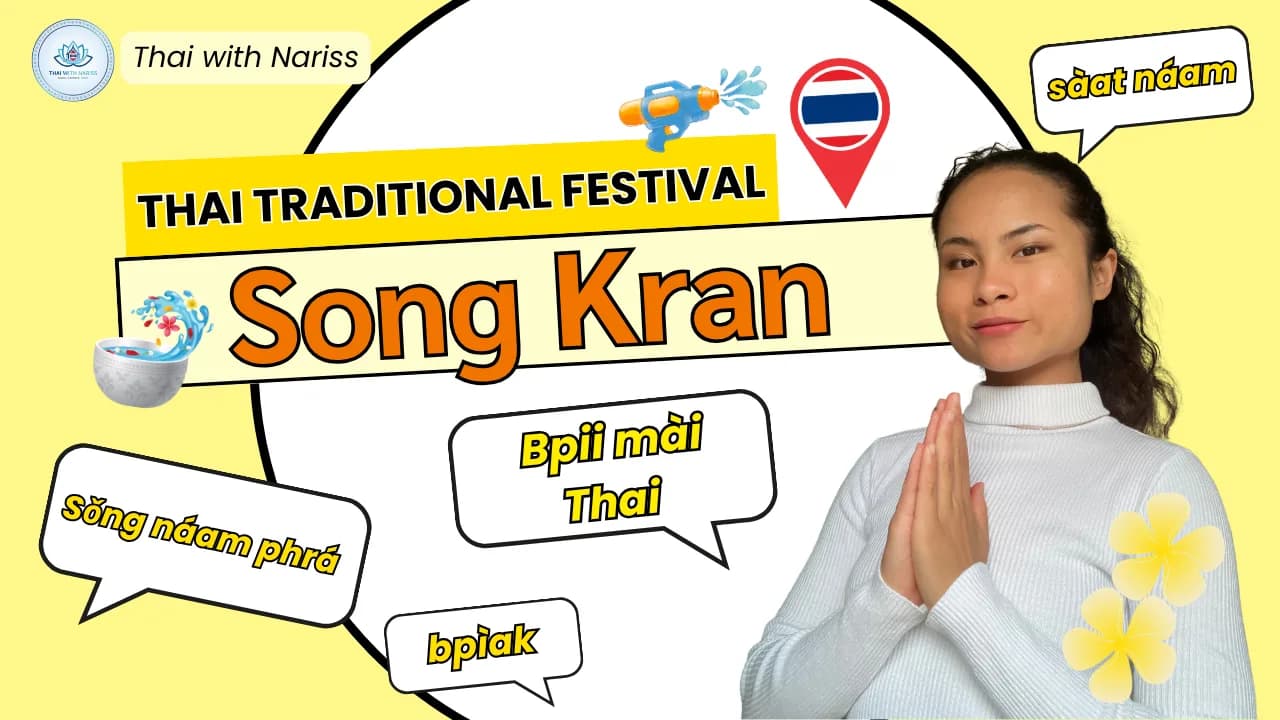
Songkran (สงกรานต์), pronounced sǒng-graan, is Thailand's traditional New Year, held every April 13 to 15. The name comes from a Sanskrit word for the sun moving into a new zodiac sign. Most people know it as the world's biggest water fight, but underneath the splashing it is a Buddhist festival about cleansing the old year and showing respect to elders.
I celebrate Songkran every year, and every year my students ask me the same two things: what is it really about, and how do I join in without doing something rude? If you are learning your first basic Thai phrases before a trip, this is the one week that puts all of them to use at once. This is what I tell them before the holiday.
What Songkran Actually Is
Songkran is the Thai New Year. For centuries Thailand set its calendar by the sun, and Songkran marks the point when the sun moves into Aries. That is why it always lands in mid-April, after the rice harvest, when the weather is at its hottest and a bucket of cold water is very welcome.
The government fixes the public holiday on April 13, 14, and 15, and each day has its own name. April 13 is National Elderly Day, when families honor their grandparents. April 14 is National Family Day. April 15 is the first day of the new year proper. In practice the water fights ignore these boundaries, and in some towns the celebration runs much longer.
In December 2023, UNESCO added the festival to its Representative List of the Intangible Cultural Heritage of Humanity, under the name "Songkran in Thailand, traditional Thai New Year festival." For a holiday that visitors often picture as one huge street party, that listing is a reminder of how much history sits behind the water.
Where the Water Comes From
The water is not random. It started as a blessing.
At the temple, people pour cool, jasmine-scented water over Buddha images to clean them for the new year, a ritual called sǒng nám phrá. At home, younger family members pour scented water gently over the palms, and sometimes the feet, of their parents and grandparents, ask forgiveness for the past year, and receive a blessing in return. This one is called rót nám dam hǔa, and for many Thai families it is the most meaningful moment of the whole festival.
| Thai | Pronunciation | English |
|---|---|---|
| สรงน้ำพระ | sǒng nám phrá | bathing the Buddha image |
| รดน้ำดำหัว | rót nám dam hǔa | pouring scented water over elders' hands for a blessing |
สรงน้ำพระ
sǒng nám phrá
bathing the Buddha image
รดน้ำดำหัว
rót nám dam hǔa
pouring scented water over elders' hands for a blessing
Somewhere over the years, a gentle pour of scented water over an elder's hands grew into teenagers with buckets on the back of a pickup truck. The quiet gesture and the loud game share the same root: water washes off the old year and starts the new one clean. When a stranger tips a bowl over your shoulder in the street, that is what they are wishing you, even if it does not feel spiritual in the moment.
More Than a Water Fight
Before any water gets thrown, most Thai families start the holiday quietly. On the morning of April 13, people clean the house from top to bottom, the way many cultures do a spring clean, to clear out the old year. Then they go to the temple.
At the temple people give alms to the monks and listen to a short sermon. Making merit, which Thais call tham bun (ทำบุญ), is the point of the morning. One custom you will see in temple grounds is the building of small sand pagodas. People carry sand in, shape it into little stupas, and decorate them with flags and flowers. It is partly symbolic and partly practical: you are giving back the sand that clung to your feet and left the temple over the year, and earning merit while you do it.
April 14, Family Day, is exactly what it sounds like. People who work in Bangkok travel back to their home provinces, grandparents cook for everyone, and the pouring of scented water over elders' hands usually happens on this day. If a Thai family invites you in during Songkran, this is the side of the festival the street cameras never show, and it is worth saying yes to.
Songkran and New Year Phrases
A few words go a long way during Songkran. The two you will hear most are the general New Year greeting and the one made for the festival itself.
| Thai | Pronunciation | English |
|---|---|---|
| สวัสดีปีใหม่ไทย | sà-wàt-dii bpii mài Thai | Happy Thai New Year |
| สุขสันต์วันสงกรานต์ | sùk-sǎn wan sǒng-graan | Happy Songkran |
| เล่นน้ำ | lên nám | to play in the water (join the water fight) |
| สาดน้ำ | sàat nám | to splash water |
สวัสดีปีใหม่ไทย
sà-wàt-dii bpii mài Thai
Happy Thai New Year
สุขสันต์วันสงกรานต์
sùk-sǎn wan sǒng-graan
Happy Songkran
เล่นน้ำ
lên nám
to play in the water (join the water fight)
สาดน้ำ
sàat nám
to splash water
Add khráp if you are a man or khà if you are a woman to make any of these polite. The particle follows the speaker, not the person you are talking to. If you want the fuller set of new year and everyday greetings, I cover them in my guide to Thai greetings, which pairs well with the festival phrases here.
Songkran on Koh Samui
Here on Samui, Songkran has two faces. If you want the full water-war experience, Chaweng Beach Road is where it happens. The road turns into a slow river of pickup trucks, foam, loud music, and people with water guns, and for a few days you cannot walk down it without getting soaked. It is chaotic, and it is a lot of fun if that is what you came for.
If you would rather keep it gentle, the quieter neighborhoods like Plai Laem, Maenam, and the villages inland stay much calmer. You will still get a friendly splash at the fresh market or outside 7-Eleven, but nothing full-on. The temples around the island hold their morning ceremonies whatever the beach roads are doing. If you are mapping out your days, my list of things to do on Koh Samui can help you balance the wet chaos with the quieter corners. Check the opening days before you set off, though. Songkran is a national holiday, and plenty of places close for it.
The Unwritten Rules
Songkran feels like a free-for-all, but there are lines you do not cross.
Never splash a monk. Monks are off limits. If you want to take part in the blessing, sprinkle a little water over a Buddha statue instead. Malls like Lotus's set one up for the festival, so you will not have to look far. Be gentle with elderly people and with babies, and if someone signals that they do not want to play, respect it right away. Business owners, security guards, and anyone clearly on their way to work in dry clothes are usually a no as well.
Go easy on people riding motorbikes. A face full of cold water at speed causes real accidents, and the roads are already the most dangerous part of the holiday. If you truly cannot resist, aim low, or just skip them.
Ice water is a mean trick. The water is meant to be cool and refreshing, not a shock to the system. And waterproof your phone before you step outside. A cheap dry pouch from any 7-Eleven will save you a very bad afternoon. Assume everything you carry into a Songkran crowd is going to get wet.
What to Bring for a Songkran Day
If you are heading into a water zone, pack light and pack for wet. Here is what I tell my students to carry:
- A dry bag or sealed waterproof pouch for your phone, cash, and hotel key.
- Sandals with some grip, since the streets get slick and flip-flops slide.
- Quick-dry clothes you do not care about. Light colors go see-through when wet, so choose accordingly.
- Sunglasses or cheap goggles to keep water and foam out of your eyes.
- A small water gun or bucket if you want to join in, easy to buy from any street stall in April.
- Sunscreen, because you are outside for hours and the water rinses it off fast.
Leave your passport, your good camera, and anything you cannot replace back at the hotel. If it cannot get wet, it should not be with you.
If You Would Rather Stay Dry
Not everyone wants three days of water, and that is completely fine. Plenty of Thais spend Songkran quietly with family, and plenty of travelers plan around it.
To stay dry, keep off the main party roads from late morning to evening, when the water fights peak. Mornings are calm almost everywhere, so that is your window for temples, markets, and photos. Quiet neighborhoods, shopping malls, and many hotels stay dry through the day, and some resorts set up gentle, family-friendly water zones if you want a small taste without the crowds.
One honest note before you go. Songkran week is the most dangerous stretch on Thai roads all year. The government runs a road-safety campaign it calls the seven dangerous days, and motorbike accidents climb sharply, often with alcohol involved. If you rent a scooter, this is the week to be most careful, or to leave it parked and take a taxi. Getting home dry is nice. Getting home safe matters more.
Songkran is my favorite window into how Thailand actually works: a Buddhist new year and a nationwide water fight sharing the same three days, with real respect for elders running underneath it all. Learn a few of the phrases above, keep the rules in mind, and you will be pulled into it rather than left watching from the side. If you want to land in April already able to greet people, order food, and handle a market stall, my Thai for Travelers course gets you there with native audio and the exact phrases you will need that week.