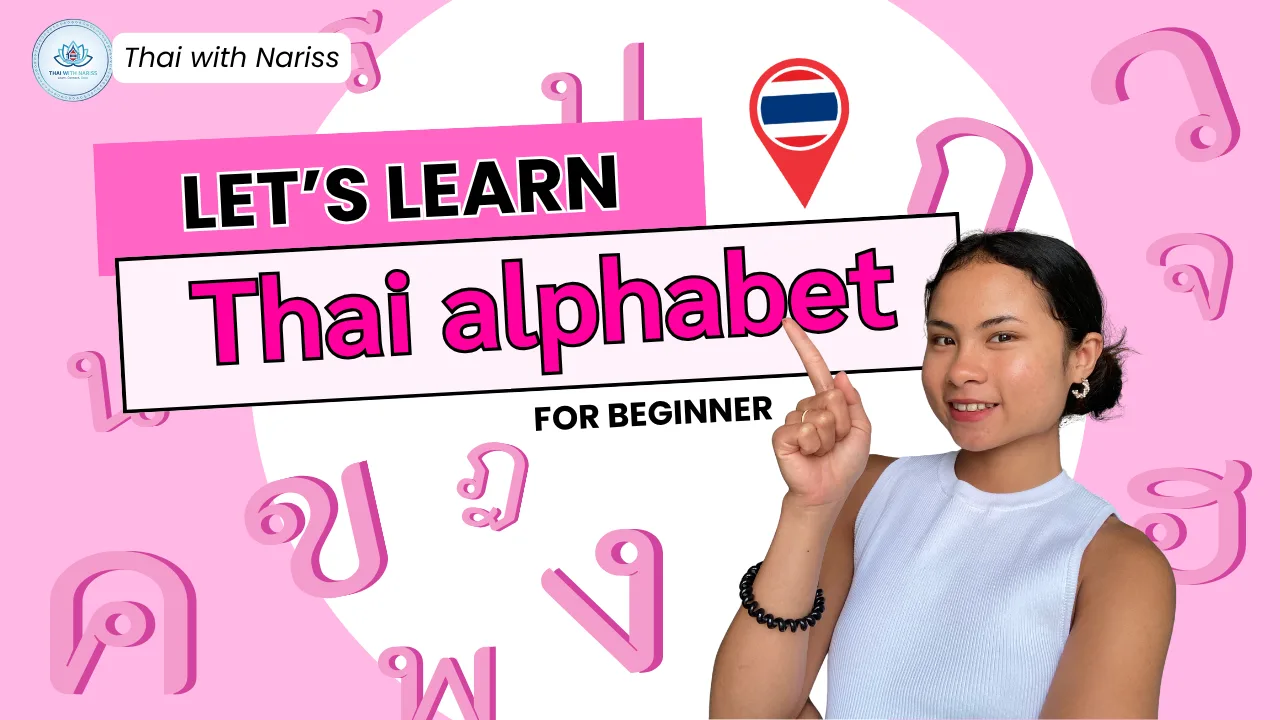
The Thai alphabet is an abugida, a script where vowels are written as marks around consonants. It has 44 consonants, two of them now obsolete, plus around 32 vowel forms and four tone marks. There are no capital letters, words run together with no spaces, and every letter stands for a sound.
That last point is the good news I give every beginner. Thai looks like a dense tangle of curls and hooks, but it is a phonetic system, so once you know the letters you can sound out words the way you did as a child in your own language. If you are just getting started, this article fits right after my overview for people learning Thai as a beginner. Below is the whole script, laid out the way I do it in a first lesson.
What Makes the Thai Script Different
Thai is an abugida, which is a fancy word for a simple idea: each consonant carries a built-in vowel sound, usually a short "o" or "a", and you only write a separate vowel when you want a different one. So a single consonant is already a syllable you can say out loud. English works differently, where every vowel has to be written.
A few things surprise my students on day one. There are no capital letters, so a name and an ordinary word look the same. There are no spaces between words inside a sentence. And the vowels do not sit politely in a line after the consonant. They can appear in front of it, behind it, on top, or underneath, and sometimes they wrap around both sides at once.
One worry I hear a lot: people assume Thai letters are like Chinese characters, where each symbol is a whole word you have to memorize. They are not. Thai is a sound-based alphabet, closer in spirit to the Roman letters you already read, just with more of them and a different shape. Learn the sounds and you can read words you have never seen before.
The 44 Consonants
Thai has 44 consonant letters. Thai children learn them through a naming system where every letter comes paired with a picture word, the way English kids learn "A is for apple". The first letter, ก, is "gor gài", where gài means chicken, so the letter is fixed in memory next to its little drawing of a chicken. This is why you will see the alphabet called the gor gài, the same way we say "the ABCs".
Here are some of the most common letters with their picture words.
| Thai | Pronunciation | English |
|---|---|---|
| ก ไก่ | gor gài | chickenSound: g |
| ข ไข่ | khǒr khài | eggSound: kh |
| ค ควาย | khor khwaai | buffaloSound: kh |
| ง งู | ngor nguu | snakeSound: ng |
| จ จาน | jor jaan | plateSound: j |
| ช ช้าง | chor cháang | elephantSound: ch |
| ม ม้า | mor máa | horseSound: m |
| ล ลิง | lor ling | monkeySound: l |
| ส เสือ | sǒr sʉ̌a | tigerSound: s |
| ป ปลา | bpor bplaa | fishSound: bp |
ก ไก่
gor gài
chicken
Sound: g
ข ไข่
khǒr khài
egg
Sound: kh
ค ควาย
khor khwaai
buffalo
Sound: kh
ง งู
ngor nguu
snake
Sound: ng
จ จาน
jor jaan
plate
Sound: j
ช ช้าง
chor cháang
elephant
Sound: ch
ม ม้า
mor máa
horse
Sound: m
ล ลิง
lor ling
monkey
Sound: l
ส เสือ
sǒr sʉ̌a
tiger
Sound: s
ป ปลา
bpor bplaa
fish
Sound: bp
Two of the 44 are officially retired. You will see them in the full chart, but no one writes with them anymore, so a beginner can note them and move on.
| Thai | Pronunciation | English |
|---|---|---|
| ฃ ขวด | khǒr khùat | bottleObsolete, replaced by ข |
| ฅ คน | khor khon | personObsolete, replaced by ค |
ฃ ขวด
khǒr khùat
bottle
Obsolete, replaced by ข
ฅ คน
khor khon
person
Obsolete, replaced by ค
You will notice several letters make sounds that look identical in English, like the two "kh" letters above. That is not a mistake. They sound the same today but belong to different tone groups, which is the next piece of the puzzle.
Three Classes of Consonants
Every Thai consonant belongs to one of three classes: middle, high, or low. There are 9 middle-class letters, 11 high-class letters, and 24 low-class letters. The names have nothing to do with importance or difficulty. They are just labels for how each letter behaves when it comes to tone.
Here is why the classes exist, and it is the part that makes Thai click once you see it. Thai is a tonal language, so the same syllable said with a different pitch is a different word. The tone of a syllable is decided by three things working together: the class of the consonant, the length of the vowel, and any tone mark. The consonant class sets the starting point, and the rest adjusts from there.
You do not need to memorize all 44 letters by class before you can read anything. My students pick up the class of each letter gradually, as a side effect of learning the letters themselves. For now, the useful takeaway is simply that a letter's class is part of its identity, like knowing whether an English letter is a vowel or a consonant.
Vowels Wrap Around the Consonant
This is the feature that throws newcomers the most, so take it slowly. A Thai vowel is written in relation to its consonant, and its position on the page does not always match the order you say it. The classic example is the vowel เ, which is written in front of the consonant but pronounced after it.
Thai has around 32 vowel forms, built from a smaller set of basic symbols that combine into long and short versions. You do not learn them as a list. You learn them as you meet them in words. Here are common ones in each position, using real words you will hear on Samui every day.
| Thai | Pronunciation | English |
|---|---|---|
| มา | maa | to comeา is a long "aa", written after the consonant |
| ไป | bpai | to goไ is "ai", written before the consonant |
| มี | mii | to haveThe "ii" mark sits above the consonant |
| คุณ | khun | youThe "u" mark sits below the consonant |
| เรา | rao | we, usเ...า wraps around both sides |
มา
maa
to come
า is a long "aa", written after the consonant
ไป
bpai
to go
ไ is "ai", written before the consonant
มี
mii
to have
The "ii" mark sits above the consonant
คุณ
khun
you
The "u" mark sits below the consonant
เรา
rao
we, us
เ...า wraps around both sides
Notice that ไป is written with the vowel first but spoken bpai, vowel last. Your eyes learn to jump to the consonant, then place the vowel around it. It feels strange for about a week, and then it feels normal.
The Four Tone Marks
Standard Thai has five tones: mid, low, falling, high, and rising. To write them, the script uses four tone marks, small symbols that sit above the consonant. The reason there are five tones but only four marks is that the base tone already comes from the consonant class and the vowel, so a mark is often not needed at all. When a mark does appear, it adjusts the tone from that base.
| Thai | Pronunciation | English |
|---|---|---|
| ่ | mái èek | first tone markMost common |
| ้ | mái thoo | second tone markVery common |
| ๊ | mái trii | third tone markRarer |
| ๋ | mái jàt-tà-waa | fourth tone markRarest |
่
mái èek
first tone mark
Most common
้
mái thoo
second tone mark
Very common
๊
mái trii
third tone mark
Rarer
๋
mái jàt-tà-waa
fourth tone mark
Rarest
Here is the point that saves beginners a lot of confusion: a tone mark does not always produce the same tone. Mái èek on a low-class consonant gives a different result than mái èek on a high-class one. That is why the classes matter. The mark and the class are read together, not separately. It sounds like a lot, and it becomes automatic with practice, the same way you stopped thinking about silent letters in English.
Thai Has Its Own Numbers Too
Alongside the Arabic numerals you already know, Thai has its own set of digits. Thai numerals are used less than they once were, since the Arabic ones appear on most keyboards and price tags, but you still meet them in specific places: temple signage, government documents, official forms, banknotes, and some traditional restaurants that write prices the old way.
| Thai | Pronunciation | English |
|---|---|---|
| ๐ | sǔun | 0 |
| ๑ | nʉ̀ng | 1 |
| ๒ | sǎwng | 2 |
| ๓ | sǎam | 3 |
| ๔ | sìi | 4 |
| ๕ | hâa | 5 |
| ๖ | hòk | 6 |
| ๗ | jèt | 7 |
| ๘ | bpàet | 8 |
| ๙ | gâo | 9 |
๐
sǔun
0
๑
nʉ̀ng
1
๒
sǎwng
2
๓
sǎam
3
๔
sìi
4
๕
hâa
5
๖
hòk
6
๗
jèt
7
๘
bpàet
8
๙
gâo
9
Learning to recognize ๑ ๒ ๓ is worth an afternoon. It means you can read a temple donation box or a set menu at a local place that has not switched to Arabic numerals, and it is a small win that makes the whole script feel more familiar.
No Spaces Between Words
In Thai, sentences are written as one continuous string of letters. There are no spaces between words. A space usually marks the end of a clause or a sentence, roughly where you might use a comma or a full stop in English. So a Thai sentence can look like one very long word to a beginner.
Thai readers parse this the same way you read your own language without sounding out every letter. They recognize the shape of common words and know where one word ends and the next begins from context and grammar. It is a skill that builds naturally once you know the letters, and it is one of the biggest differences between reading Thai and reading English. I go deeper into how the two languages are built in my article on how Thai and English are structured differently.
Because there is no capitalization and no spacing to lean on, punctuation gives you far fewer clues than you are used to. This is exactly why reading practice matters. You are training your eye to see the word boundaries that the page does not mark for you.
How Long Does It Really Take?
Let me give you the honest teacher answer instead of a marketing one. Most of my students learn to recognize all the letters in a few weeks of short daily practice, say fifteen or twenty minutes a day. Recognizing the letters is not the same as reading smoothly, though. Comfortable reading, where your eyes stop decoding one symbol at a time and start seeing whole words, usually takes a few months.
The vowels and tone rules are what stretch that timeline, not the consonants. The consonants are just shapes to memorize. The tone system asks you to hold three pieces of information at once, and that only speeds up with repetition. There is no shortcut, but there is a reliable path, and it is a lot shorter than people fear.
The students who get there fastest are the ones who practice a little every day rather than cramming once a week. Ten minutes with the letters over breakfast beats a two-hour session on Sunday. That is true for almost any language, and it is very true for a script that is new to your eyes.
Meet Your First Five Letters
Before you go, here is something you can actually do today. Here are five letters, chosen because they combine into simple real words. Learn these shapes and their sounds first.
| Thai | Pronunciation | English |
|---|---|---|
| ก ไก่ | gor gài | chickenSound: g |
| ม ม้า | mor máa | horseSound: m |
| น หนู | nor nǔu | mouseSound: n |
| ป ปลา | bpor bplaa | fishSound: bp |
| า | sà-rà aa | long "aa"The vowel written after |
ก ไก่
gor gài
chicken
Sound: g
ม ม้า
mor máa
horse
Sound: m
น หนู
nor nǔu
mouse
Sound: n
ป ปลา
bpor bplaa
fish
Sound: bp
า
sà-rà aa
long "aa"
The vowel written after
Now a recognition drill. Below are three short words built only from letters you just met. Look at the first consonant in each one, name it out loud, then check the answers underneath.
- มา
- นา
- กา
| Thai | Pronunciation | English |
|---|---|---|
| มา | maa | to comeStarts with ม (mor máa) |
| นา | naa | rice fieldStarts with น (nor nǔu) |
| กา | gaa | crowStarts with ก (gor gài) |
มา
maa
to come
Starts with ม (mor máa)
นา
naa
rice field
Starts with น (nor nǔu)
กา
gaa
crow
Starts with ก (gor gài)
If you can spot those first letters, you just read your first Thai words. That is the whole game, repeated with more letters until it becomes second nature.
When you are ready to turn these shapes into actual reading, my guide on how to read Thai takes the next step and walks you through sounding out full syllables. And if you want structured practice away from the screen, my beginner reading ebooks give you short Thai stories with phonetics and vocabulary lists to work through in your own time. Pick five letters this week and say them out loud. That is how every Thai reader starts.