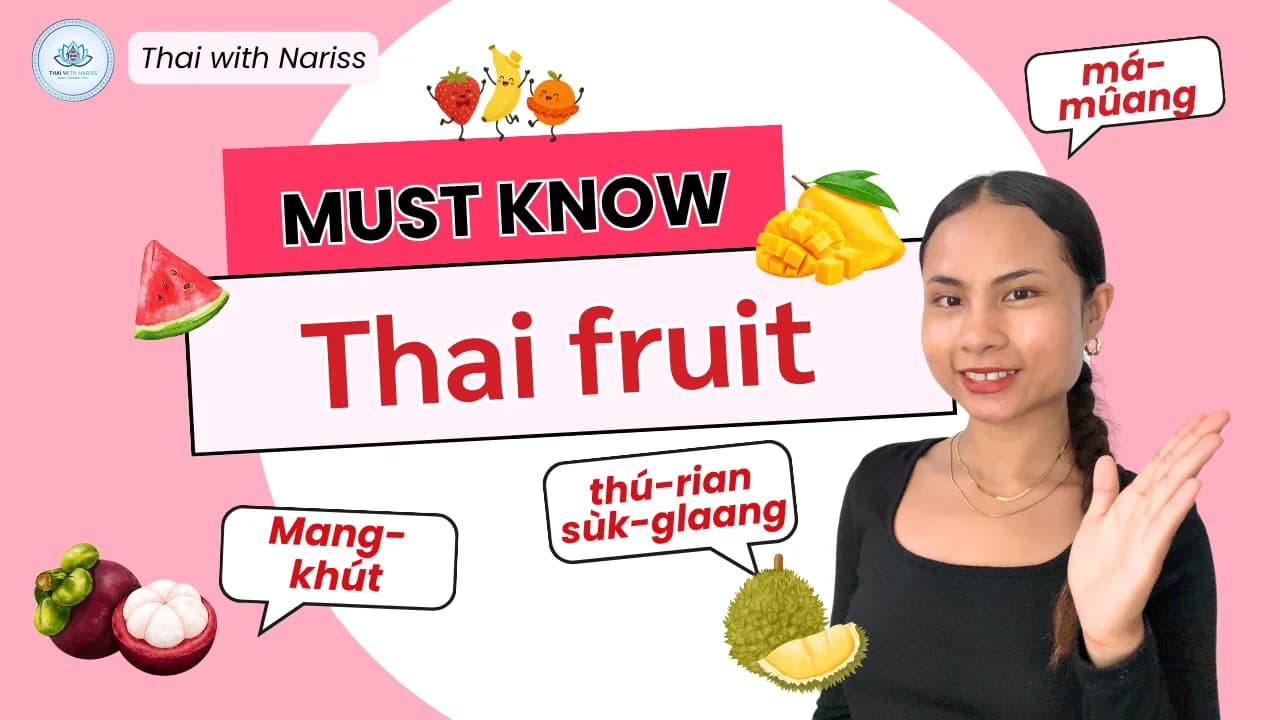
Fruit in Thai is pǒn-lá-máai (ผลไม้), and here it is everywhere: stacked on market tables in the morning and sold in cold bags from carts by the roadside all afternoon. The words you need most are the fruit names, plus a handful of phrases for buying at the market. This guide covers both.
You do not need many words to shop for fruit here, but the ones you do need come up every single day. If you are still building your first set of everyday Thai, my list of basic Thai phrases is a good place to start, and the fruit words below slot right in next to them. These are the ones my students reach for most.
Pǒn-lá-máai: Fruit in Thai
The general word for fruit is pǒn-lá-máai, built from pǒn (a piece of produce) and máai (tree, wood). You will hear it at the fresh market, which is dtà-làat (ตลาด), and you will see it spelled on the side of a hundred fruit carts. Here on Samui the songthaew (สองแถว) often passes three or four stalls before it reaches the beach, each one piled with something in season.
| Thai | Pronunciation | English |
|---|---|---|
| ผลไม้ | pǒn-lá-máai | Fruit (general) |
| ร้านผลไม้ | ráan pǒn-lá-máai | Fruit shop / cart |
| ตลาด | dtà-làat | Market |
ผลไม้
pǒn-lá-máai
Fruit (general)
ร้านผลไม้
ráan pǒn-lá-máai
Fruit shop / cart
ตลาด
dtà-làat
Market
The Fruits You Will Meet First
These are the fruits you will run into your first week, at breakfast buffets, in shakes, and cut up in a 7-Eleven cold case. Papaya (má-lá-gaw) is worth a special note: sold ripe and orange it is a soft breakfast fruit, but sold green and shredded it becomes sôm-dtam, the fiery papaya salad. Green mango gets the same treatment, eaten firm and sour with a chili-salt dip.
| Thai | Pronunciation | English |
|---|---|---|
| มะม่วง | má-mûang | Mango |
| กล้วย | glûay | Banana |
| สับปะรด | sàp-bpà-rót | Pineapple |
| แตงโม | dtaeng-moh | Watermelon |
| มะละกอ | má-lá-gaw | Papaya |
| มะพร้าว | má-práao | Coconut |
| ส้ม | sôm | Orange |
มะม่วง
má-mûang
Mango
กล้วย
glûay
Banana
สับปะรด
sàp-bpà-rót
Pineapple
แตงโม
dtaeng-moh
Watermelon
มะละกอ
má-lá-gaw
Papaya
มะพร้าว
má-práao
Coconut
ส้ม
sôm
Orange
The Famous Four
Then there are the four everyone asks me about. Durian (thú-rian) is the heavy, custard-textured one with the smell that starts arguments, and it gets its own section below. Mangosteen (mang-khút) is the fruit almost nobody dislikes: a hard purple shell you press open to reach cool white segments, sweet with a little tartness. Rambutan (ngó) hides lychee-like flesh under a red shell covered in soft hairs, and it is easy to eat by the bag. Longan (lam-yai) is small and brown-shelled, honey-sweet inside, and the best of it comes from Lamphun up north.
| Thai | Pronunciation | English |
|---|---|---|
| ทุเรียน | thú-rian | Durian |
| มังคุด | mang-khút | Mangosteen |
| เงาะ | ngó | Rambutan |
| ลำไย | lam-yai | Longan |
ทุเรียน
thú-rian
Durian
มังคุด
mang-khút
Mangosteen
เงาะ
ngó
Rambutan
ลำไย
lam-yai
Longan
Buying Fruit at the Market
Four short phrases will carry you through almost any fruit stall. Ask the price by the kilo, ask if it is sweet, ask to taste, and ask for a ripe one. The polite particle at the end follows you, the speaker: khráp if you are a man, khá if you are a woman.
| Thai | Pronunciation | English |
|---|---|---|
| กิโลละเท่าไหร่ | gì-loh-lá thâo-rài? | How much per kilo? |
| หวานไหม | wǎan mái? | Is it sweet? |
| ขอชิมได้ไหม | khǎw chim dâai mái? | Can I try a piece? |
| เอาลูกที่สุกนะ | ao lûuk thîi sùk ná | Give me a ripe one |
กิโลละเท่าไหร่
gì-loh-lá thâo-rài?
How much per kilo?
หวานไหม
wǎan mái?
Is it sweet?
ขอชิมได้ไหม
khǎw chim dâai mái?
Can I try a piece?
เอาลูกที่สุกนะ
ao lûuk thîi sùk ná
Give me a ripe one
Here is how a real exchange sounds when you buy a couple of kilos of mango. Read it out loud once and the rhythm sticks.
| Thai | Pronunciation | English |
|---|---|---|
| มะม่วงกิโลละเท่าไหร่คะ | má-mûang gì-loh-lá thâo-rài khá? | You: How much are mangoes per kilo? |
| กิโลละหกสิบบาทค่ะ | gì-loh-lá hòk-sìp bàat khà | Vendor: Sixty baht a kilo. |
| หวานไหมคะ | wǎan mái khá? | You: Are they sweet? |
| หวานมากค่ะ ชิมได้เลย | wǎan mâak khà, chim dâai loei | Vendor: Very sweet, go ahead and try. |
| เอาสองกิโลค่ะ ขอลูกสุกๆ นะคะ | ao sǎwng gì-loh khà, khǎw lûuk sùk-sùk ná khá | You: Two kilos please, ripe ones. |
| ได้ค่ะ | dâai khà | Vendor: Sure. |
มะม่วงกิโลละเท่าไหร่คะ
má-mûang gì-loh-lá thâo-rài khá?
You: How much are mangoes per kilo?
กิโลละหกสิบบาทค่ะ
gì-loh-lá hòk-sìp bàat khà
Vendor: Sixty baht a kilo.
หวานไหมคะ
wǎan mái khá?
You: Are they sweet?
หวานมากค่ะ ชิมได้เลย
wǎan mâak khà, chim dâai loei
Vendor: Very sweet, go ahead and try.
เอาสองกิโลค่ะ ขอลูกสุกๆ นะคะ
ao sǎwng gì-loh khà, khǎw lûuk sùk-sùk ná khá
You: Two kilos please, ripe ones.
ได้ค่ะ
dâai khà
Vendor: Sure.
When Is Mango Season?
Mango season is the hot season. From around March to May the market fills with má-mûang, and mango with sticky rice, khâao nǐao má-mûang, shows up at every dessert cart. That is the window locals wait for all year.
The famous rainy-season fruits come next. Durian, mangosteen, and rambutan overlap through the wet months, roughly May into August, and longan (lam-yai) runs a little later, from about July to September. A handful of fruits barely have a season at all: banana, papaya, pineapple, coconut, and watermelon are on the tables year-round. A useful habit is reading ripeness by color, from the green of a firm sour mango to the gold of a soft sweet one, and my guide to colors in Thai gives you those words.
| Thai | Pronunciation | English |
|---|---|---|
| หน้ามะม่วง | nâa má-mûang | Mango season |
| ข้าวเหนียวมะม่วง | khâao nǐao má-mûang | Mango with sticky rice |
| สุก | sùk | Ripe |
| ดิบ | dìp | Unripe (green) |
หน้ามะม่วง
nâa má-mûang
Mango season
ข้าวเหนียวมะม่วง
khâao nǐao má-mûang
Mango with sticky rice
สุก
sùk
Ripe
ดิบ
dìp
Unripe (green)
Fruit Shakes and Street Carts
A fruit shake is a blended fruit drink, and the key word is bpàn, meaning blended. Point at the fruit you want and add bpàn: watermelon shake is dtaeng-moh bpàn. Carts sweeten shakes by default, so if you want it plain, say mâi sài náam-dtaan, no sugar, or wǎan náwy for a little less sweet.
The other cart to know sells cut fruit in a bag. Green mango, guava (which is also the Thai word for a Westerner), pineapple, and watermelon come chopped cold, with a small corner packet of phrík glʉa, a chili-salt dip that usually has sugar in it too. Dipping sour green fruit into it is a very Thai thing to do, and it grows on you fast.
| Thai | Pronunciation | English |
|---|---|---|
| แตงโมปั่น | dtaeng-moh bpàn | Watermelon shake |
| ไม่ใส่น้ำตาล | mâi sài náam-dtaan | No sugar |
| หวานน้อย | wǎan náwy | Less sweet |
| ฝรั่ง | fà-ràng | Guava (also the word for a Westerner) |
| พริกเกลือ | phrík glʉa | Chili-salt dip |
แตงโมปั่น
dtaeng-moh bpàn
Watermelon shake
ไม่ใส่น้ำตาล
mâi sài náam-dtaan
No sugar
หวานน้อย
wǎan náwy
Less sweet
ฝรั่ง
fà-ràng
Guava (also the word for a Westerner)
พริกเกลือ
phrík glʉa
Chili-salt dip
Durian Has Rules
Thais call durian raa-chaa pǒn-lá-máai, the king of fruits, and it comes with more rules than any other. The smell gets it banned from a lot of hotels, from planes, and from the Bangkok metro, where you will spot the round no-durian sign on the door. None of that stops anyone from eating it. People buy it fresh by the pod, eat it with sticky rice as khâao nǐao thú-rian, or keep it frozen for later.
My honest advice: try it once, start with a small piece of a mild variety rather than the strongest one on the stall, and ask for it sùk glaang, medium ripe. You will know within one bite which side of the argument you land on. I still find it funny how fast people decide.
| Thai | Pronunciation | English |
|---|---|---|
| ทุเรียน | thú-rian | Durian |
| ราชาผลไม้ | raa-chaa pǒn-lá-máai | King of fruits |
| ข้าวเหนียวทุเรียน | khâao nǐao thú-rian | Durian with sticky rice |
| สุกกลาง | sùk glaang | Medium ripeThe one to ask for. Too ripe, durian goes very soft, smells gassy, and does not taste its best |
ทุเรียน
thú-rian
Durian
ราชาผลไม้
raa-chaa pǒn-lá-máai
King of fruits
ข้าวเหนียวทุเรียน
khâao nǐao thú-rian
Durian with sticky rice
สุกกลาง
sùk glaang
Medium ripe
The one to ask for. Too ripe, durian goes very soft, smells gassy, and does not taste its best
Fruit is one of the best things to practice Thai on, because you get to eat your homework. When a trip is coming up, my Thai for Travelers course builds on these market phrases with the ordering and bargaining you will use from your first day, all with native audio. Walk up to the fruit cart nearest your hotel and try one line. That is how it starts.