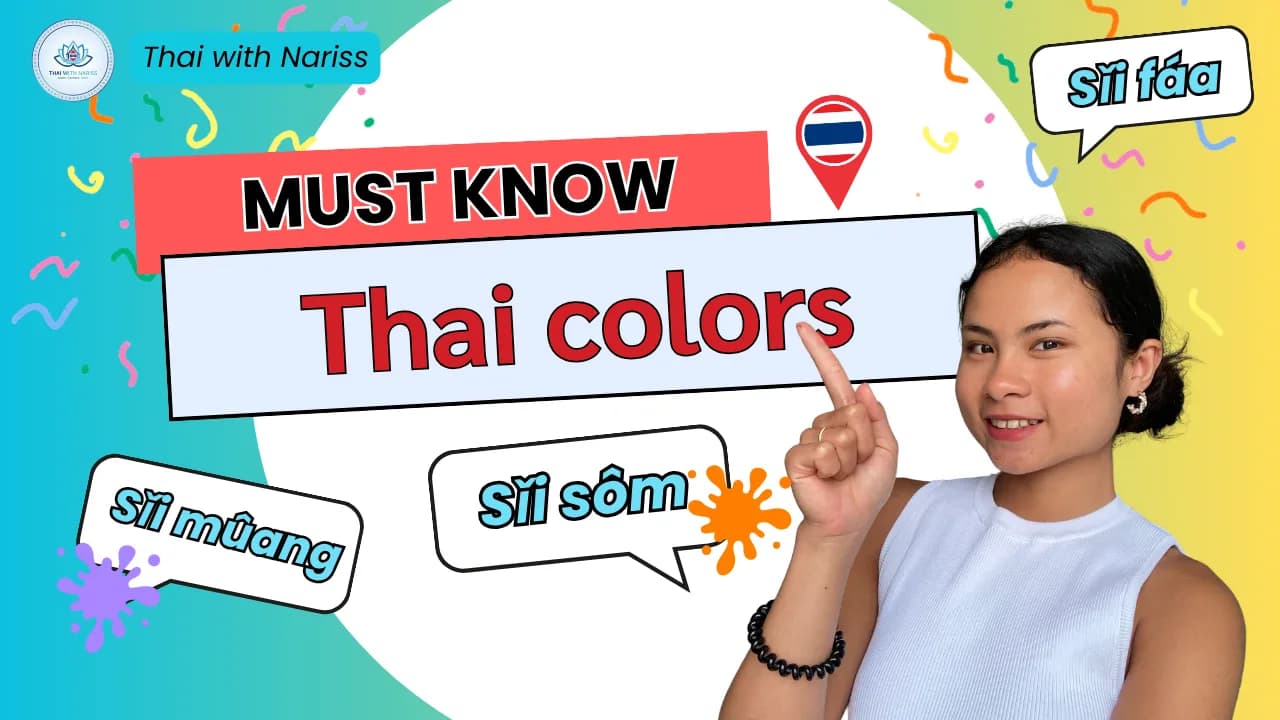
Colors in Thai start with one small word: sǐi (สี), which just means color. You put it in front of the color, so red is sǐi daaeng (สีแดง) and green is sǐi khǐao (สีเขียว). Learn sǐi plus about eleven color words, and you can describe almost anything you see here.
Colors are one of those early wins in the language, sitting right next to counting. If you have already worked through my guide to Thai numbers, you know the rhythm: a small set of building blocks that combine in predictable ways. Colors reward you fast, because you use them the moment you shop, order fruit, or point out someone across the room.
Sii: How Colors Work in Thai
Sǐi (สี) means color, and it does most of the work. To name any color, you say sǐi followed by the color word. The color word never changes shape the way adjectives do in some languages, so once you know sǐi daaeng for red, you are set.
The one habit English speakers have to unlearn is word order. In Thai the color comes after the thing it describes, not before it. A red shirt is sûea sǐi daaeng (เสื้อสีแดง), literally "shirt color red". A white dog is mǎa sǐi khǎaw (หมาสีขาว). Put the color first and a Thai listener will still follow you, but it marks you as new to the language.
| Thai | Pronunciation | English |
|---|---|---|
| สี | sǐi | color |
| เสื้อสีแดง | sûea sǐi daaeng | a red shirt |
| หมาสีขาว | mǎa sǐi khǎaw | a white dog |
สี
sǐi
color
เสื้อสีแดง
sûea sǐi daaeng
a red shirt
หมาสีขาว
mǎa sǐi khǎaw
a white dog
The Basic Thai Colors
Here are the everyday colors, the ones that cover almost every conversation. Brown is worth a smile: it is náam-dtaan (น้ำตาล), which is also the Thai word for palm sugar, so you are literally calling the color "sugar".
| Thai | Pronunciation | English |
|---|---|---|
| สีแดง | sǐi daaeng | red |
| สีน้ำเงิน | sǐi náam-ngern | blue (deep/navy)Sǐi fáa is the lighter sky blue |
| สีฟ้า | sǐi fáa | sky blue / light blue |
| สีเขียว | sǐi khǐao | green |
| สีเหลือง | sǐi lǔeang | yellow |
| สีดำ | sǐi dam | black |
| สีขาว | sǐi khǎaw | white |
| สีส้ม | sǐi sôm | orangeSôm also means "orange" the fruit |
| สีชมพู | sǐi chom-phuu | pink |
| สีม่วง | sǐi mûang | purple |
| สีน้ำตาล | sǐi náam-dtaan | brown |
| สีเทา | sǐi thao | grey |
สีแดง
sǐi daaeng
red
สีน้ำเงิน
sǐi náam-ngern
blue (deep/navy)
Sǐi fáa is the lighter sky blue
สีฟ้า
sǐi fáa
sky blue / light blue
สีเขียว
sǐi khǐao
green
สีเหลือง
sǐi lǔeang
yellow
สีดำ
sǐi dam
black
สีขาว
sǐi khǎaw
white
สีส้ม
sǐi sôm
orange
Sôm also means "orange" the fruit
สีชมพู
sǐi chom-phuu
pink
สีม่วง
sǐi mûang
purple
สีน้ำตาล
sǐi náam-dtaan
brown
สีเทา
sǐi thao
grey
One note on blue. Thai does not have a single catch-all word the way English does. Sǐi fáa is the pale blue of the sky, and sǐi náam-ngern is the deep blue of a navy uniform. When you mean "blue" and you are not sure which, sǐi fáa is the safer everyday choice.
Tone Traps: Khaaw, Khaaw, and Khaaw
This is the section that trips up everyone, so slow down here. Thai is tonal, which means the pitch of a syllable is part of the word, not just your mood. Change the tone and you change the meaning completely. The color white sounds almost identical to two very common words, and the only thing separating them is the tone.
| Thai | Pronunciation | English |
|---|---|---|
| ขาว | khǎaw | whiteRising tone, voice lifts up |
| ข้าว | khâaw | riceFalling tone, voice drops |
| ข่าว | khàaw | newsLow tone, voice stays low |
ขาว
khǎaw
white
Rising tone, voice lifts up
ข้าว
khâaw
rice
Falling tone, voice drops
ข่าว
khàaw
news
Low tone, voice stays low
Say them out loud in order and you can hear your voice do three different things. Rising for white, like asking a small question. Falling for rice, like a firm statement. Low and flat for news. Get white and rice mixed up at dinner and you might tell someone your rice is a lovely shade, which is the kind of slip my students and I laugh about in lessons. The fix is not speed, it is committing the tone to memory from the start.
A Color for Every Day of the Week
Thailand has an old tradition, rooted in Hindu astrology, that gives each day of the week its own color, tied to the deity believed to protect that day. Many Thais know the color of the day they were born on, and treat it as their personal lucky color. The tradition is lighter now than it once was, but it is still alive around birthdays and special occasions.
| Thai | Pronunciation | English |
|---|---|---|
| สีแดง | sǐi daaeng | Sunday: red |
| สีเหลือง | sǐi lǔeang | Monday: yellow |
| สีชมพู | sǐi chom-phuu | Tuesday: pink |
| สีเขียว | sǐi khǐao | Wednesday: green |
| สีส้ม | sǐi sôm | Thursday: orange |
| สีฟ้า | sǐi fáa | Friday: light blue |
| สีม่วง | sǐi mûang | Saturday: purple |
สีแดง
sǐi daaeng
Sunday: red
สีเหลือง
sǐi lǔeang
Monday: yellow
สีชมพู
sǐi chom-phuu
Tuesday: pink
สีเขียว
sǐi khǐao
Wednesday: green
สีส้ม
sǐi sôm
Thursday: orange
สีฟ้า
sǐi fáa
Friday: light blue
สีม่วง
sǐi mûang
Saturday: purple
Yellow is the one you will notice most. The late King Bhumibol was born on a Monday, and so was the current king, which is why yellow became the color of the monarchy. On royal birthdays you will see the whole island turn yellow: flags, shirts, banners outside the shops. Wednesday has a quiet twist too, splitting into green for the daytime and grey for the night. If you want the day names themselves and how to write dates, I cover those in my guide to months and days in Thai.
Light, Dark, and In Between
Once you have a color, you can shade it. Add àwn (อ่อน) after the color for a light or pale version, and khêm (เข้ม) for a dark or deep one. This is exactly how you ask for the fabric that is a touch lighter, or the coffee that comes out darker.
| Thai | Pronunciation | English |
|---|---|---|
| สีอ่อน | sǐi àwn | light / pale color |
| สีเข้ม | sǐi khêm | dark / deep color |
| สีฟ้าอ่อน | sǐi fáa àwn | light sky blue |
| สีเขียวเข้ม | sǐi khǐao khêm | dark green |
| สีชมพูอ่อน | sǐi chom-phuu àwn | pale pink |
| สีน้ำเงิน | sǐi náam-ngern | navy blue |
สีอ่อน
sǐi àwn
light / pale color
สีเข้ม
sǐi khêm
dark / deep color
สีฟ้าอ่อน
sǐi fáa àwn
light sky blue
สีเขียวเข้ม
sǐi khǐao khêm
dark green
สีชมพูอ่อน
sǐi chom-phuu àwn
pale pink
สีน้ำเงิน
sǐi náam-ngern
navy blue
The pattern is reliable: color first, then àwn or khêm. Sǐi mûang khêm is a deep purple, sǐi mûang àwn a soft lavender. You now have three shades of every color you learned above.
Using Colors When You Shop
Colors earn their keep at the market and in the mall. Here are the lines I hand my students before a shopping trip. The polite particle at the end follows you, the speaker: khráp if you are a man, khà if you are a woman.
| Thai | Pronunciation | English |
|---|---|---|
| มีสีอื่นไหม | mii sǐi èun mái? | Do you have another color? |
| ชอบสีฟ้า | châwp sǐi fáa | I like the blue one |
| สีนี้สดเกินไป | sǐi níi sòt gern-bpai | This color is too bright |
| มีสีเข้มกว่านี้ไหม | mii sǐi khêm gwàa níi mái? | Do you have a darker shade? |
| เอาสีขาวค่ะ | ao sǐi khǎaw khà | I'll take the white one (female speaker) |
มีสีอื่นไหม
mii sǐi èun mái?
Do you have another color?
ชอบสีฟ้า
châwp sǐi fáa
I like the blue one
สีนี้สดเกินไป
sǐi níi sòt gern-bpai
This color is too bright
มีสีเข้มกว่านี้ไหม
mii sǐi khêm gwàa níi mái?
Do you have a darker shade?
เอาสีขาวค่ะ
ao sǐi khǎaw khà
I'll take the white one (female speaker)
Two of these carry the question particle mái (ไหม), which turns a statement into a yes-or-no question. Notice it sits at the very end, after the color. A vendor will usually answer by pointing, so even if your sentence is shaky, the color word alone does a lot of the work.
Lucky Colors
You will meet the lucky-color idea most often around clothes and timing. Some Thais wear the color of the day for a small boost of good energy, or choose an outfit in their birth-day color for an interview or a wedding. Older generations and anyone into astrology take it more seriously, while plenty of younger Thais treat it as a light custom rather than a rule.
You do not need to follow any of this to be polite. It helps to recognize it, though. If a Thai friend asks what day you were born on, this is often why, and telling them opens a warm little conversation about your color. It is a small thing that makes you sound like you know the place. Your lucky color comes straight from the day colors above, each one tied to the Hindu deity who guards that day. Born on a Monday, you are yellow. Born on a Sunday, red.
Practice: Describe What You See
Try naming the color out loud before you check the answer. Say the full sǐi form, and add your own polite particle if you want the practice.
- A songthaew rattles past, painted bright red. What color is it?
- At the fruit stall you want the ripe yellow mango, not the unripe green one. Name both.
- You look out at the sea on a clear afternoon and it is pale blue. Describe it.
| Thai | Pronunciation | English |
|---|---|---|
| สีแดง | sǐi daaeng | 1. Red |
| สีเหลือง / สีเขียว | sǐi lǔeang / sǐi khǐao | 2. Yellow / green |
| สีฟ้า | sǐi fáa | 3. Light blue (the sea) |
สีแดง
sǐi daaeng
1. Red
สีเหลือง / สีเขียว
sǐi lǔeang / sǐi khǐao
2. Yellow / green
สีฟ้า
sǐi fáa
3. Light blue (the sea)
Colors show up in my lessons early, because you reach for them from the first week, whether you are buying a shirt at the fresh market or telling a taxi which building is yours. As the khǎaw, khâaw, khàaw trap showed, the words are easy and the tones are not. My Speaking Thai A1 video course starts with exactly that, the five tones drilled with my voice, so every color word you learn afterwards comes out right. It is also the next step if you are learning Thai as a beginner and want a structure to follow.