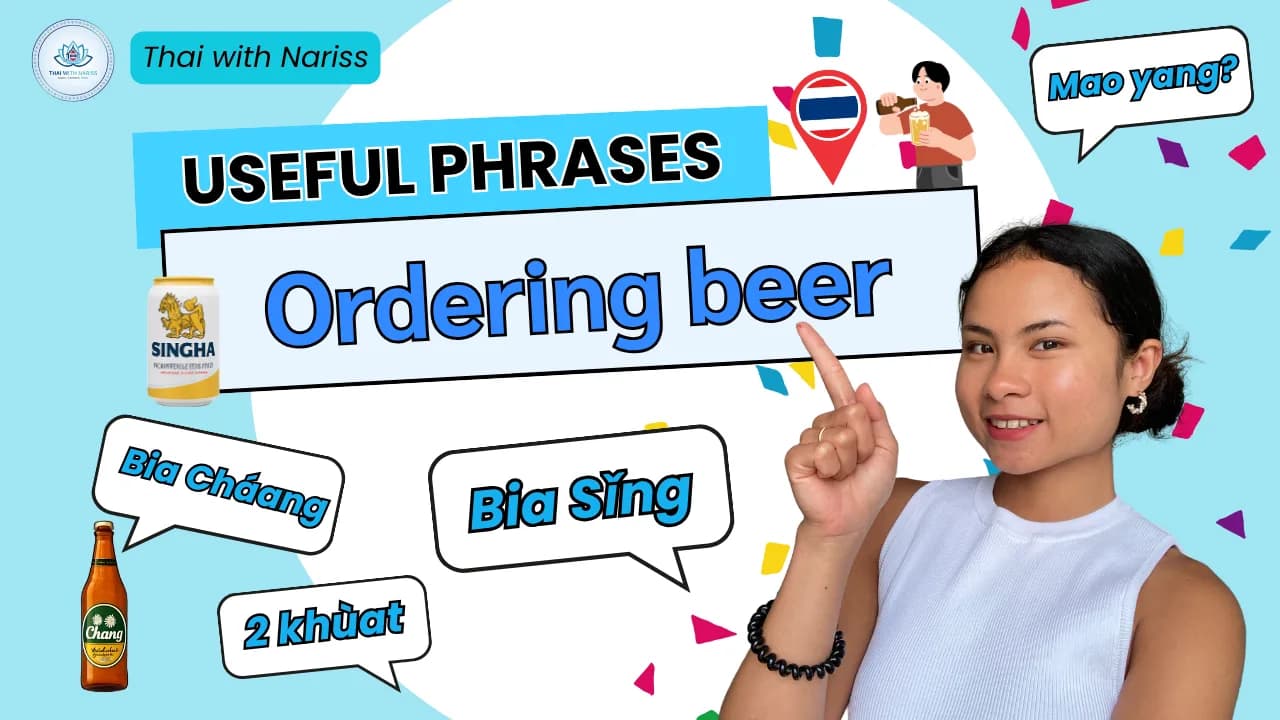
Beer in Thai is bia (เบียร์), borrowed straight from English. To order one, say khǎw bia (ขอเบียร์), meaning a beer please, and add nòi khráp if you are a man or khà if you are a woman. That single phrase gets you a cold bottle at any bar on Samui.
Thai is kind to beer drinkers, because bia is a loanword that already sits close to what you know. The rest is learning how to ask for a cold one and picking up a few local habits around the table. If you found how to say thank you in Thai easy to follow, you will be fine here too. We will go through a whole night out, from the first order to the bill.
Bia: The Thai Word for Beer
Bia (เบียร์) is the only word you need for beer in daily life. To ask for something politely, Thais wrap it in khǎw...nòi (ขอ...หน่อย), which means "may I have ..., please". Put bia in the gap and you get khǎw bia nòi, then close with your polite particle. If you are counting bottles, the classifier is khùat (ขวด), so one bottle is nèung khùat.
| Thai | Pronunciation | English |
|---|---|---|
| เบียร์ | bia | Beer |
| ขอเบียร์หน่อยครับ | khǎw bia nòi khráp | A beer, please (male speaker) |
| ขอเบียร์หน่อยค่ะ | khǎw bia nòi khà | A beer, please (female speaker) |
| ขอเบียร์หนึ่งขวด | khǎw bia nèung khùat | One bottle of beer, please |
เบียร์
bia
Beer
ขอเบียร์หน่อยครับ
khǎw bia nòi khráp
A beer, please (male speaker)
ขอเบียร์หน่อยค่ะ
khǎw bia nòi khà
A beer, please (female speaker)
ขอเบียร์หนึ่งขวด
khǎw bia nèung khùat
One bottle of beer, please
Ordering a Beer Like a Local
Thai beer usually arrives in two bottle sizes. The large bottle is about 620ml and the small one about 330ml, so a group nearly always shares big bottles poured into small glasses. Draft beer is bia sòt (เบียร์สด), literally "fresh beer", and it is worth asking for at a proper bar. When you want it properly chilled, say yen-yen (เย็นๆ). When the glass runs dry, ask for one more.
Bottles are not the only option. At 7-Eleven you will mostly grab a can, grà-pǎwng (กระป๋อง), and draft beer is ordered by the glass, gâew (แก้ว). Both words double as counting words, so two cans is sǎwng grà-pǎwng and one glass of draft is bia sòt nèung gâew.
| Thai | Pronunciation | English |
|---|---|---|
| ขออีกขวด | khǎw ìik khùat | One more bottle, please |
| ขอขวดใหญ่ | khǎw khùat yài | A large bottle, please |
| ขอขวดเล็ก | khǎw khùat lék | A small bottle, please |
| ขอเบียร์เย็นๆ | khǎw bia yen-yen | A nice cold beer, please |
| เบียร์สด | bia sòt | Draft beer |
| กระป๋อง | grà-pǎwng | Can (also the counting word for cans) |
| แก้ว | gâew | Glass (also the counting word for glasses) |
ขออีกขวด
khǎw ìik khùat
One more bottle, please
ขอขวดใหญ่
khǎw khùat yài
A large bottle, please
ขอขวดเล็ก
khǎw khùat lék
A small bottle, please
ขอเบียร์เย็นๆ
khǎw bia yen-yen
A nice cold beer, please
เบียร์สด
bia sòt
Draft beer
กระป๋อง
grà-pǎwng
Can (also the counting word for cans)
แก้ว
gâew
Glass (also the counting word for glasses)
Thai Beer Brands You Will See Everywhere
Three names cover almost every fridge on the island. Singha (Bia sǐng เบียร์สิงห์) is the original, brewed by Boon Rawd since 1933, a touch maltier and usually a few baht more. Chang (Bia cháang เบียร์ช้าง) means elephant and comes from ThaiBev; it used to be stronger at 6.4% and had a rough reputation for the morning after, but it was reeled back to 5% years ago. Leo (Bia lii-oh เบียร์ลีโอ) is the everyday favorite, brewed by Boon Rawd too, lighter and the one I see most Thai friends reach for. All three now sit at 5%, so the real difference is taste and price. Locals order by name, not by "beer", so try bia sǐng or bia lii-oh at the shop.
| Thai | Pronunciation | English |
|---|---|---|
| เบียร์สิงห์ | bia sǐng | Singha, the maltier original |
| เบียร์ช้าง | bia cháang | Chang, meaning elephant |
| เบียร์ลีโอ | bia lii-oh | Leo, the light everyday best seller |
เบียร์สิงห์
bia sǐng
Singha, the maltier original
เบียร์ช้าง
bia cháang
Chang, meaning elephant
เบียร์ลีโอ
bia lii-oh
Leo, the light everyday best seller
Cheers in Thai
The toast you will hear most is chon gâew (ชนแก้ว), which literally tells everyone to knock their glasses together. For a louder, happier moment there is chai-yoo, closer to "hooray". If a friend wants you to finish what is in front of you, that is mòt gâew, glass empty. Thais toast often across an evening, not just once at the start, and a small eye-contact clink is part of the fun.
| Thai | Pronunciation | English |
|---|---|---|
| ชนแก้ว | chon gâew | Cheers (let's clink glasses) |
| ไชโย | chai-yoo | Hooray (a shouted toast) |
| หมดแก้ว | mòt gâew | Bottoms up (finish the glass) |
| ดื่มๆ | dùuem dùuem | Drink up! |
ชนแก้ว
chon gâew
Cheers (let's clink glasses)
ไชโย
chai-yoo
Hooray (a shouted toast)
หมดแก้ว
mòt gâew
Bottoms up (finish the glass)
ดื่มๆ
dùuem dùuem
Drink up!
Table Talk: Drunk Yet?
A few rounds in, the teasing starts, and it is all friendly. Someone will lean over and ask mao yang? (เมายัง), are you drunk yet? The proud answer is yang mâi mao (ยังไม่เมา), not yet, usually said while reaching for the bottle. The party line of the night is mâi mao mâi glàp (ไม่เมาไม่กลับ), literally "not drunk, not going home", which is less a plan than a joke everyone at the table says.
Thais also talk about drinking through the throat, khaw (คอ). If one glass turns your face red, friends will laugh that you are khaw àwn (คออ่อน), a weak throat, a lightweight. The friend who is still steady at midnight is khaw khǎeng (คอแข็ง), a strong throat. Say either one with a smile and you will fit right in.
| Thai | Pronunciation | English |
|---|---|---|
| เมายัง | mao yang? | Drunk yet? |
| ยังไม่เมา | yang mâi mao | Not drunk yet |
| ไม่เมาไม่กลับ | mâi mao mâi glàp | Not going home till we're drunk (joking) |
| คออ่อน | khaw àwn | Lightweight (weak throat) |
| คอแข็ง | khaw khǎeng | Can hold their drink (strong throat) |
เมายัง
mao yang?
Drunk yet?
ยังไม่เมา
yang mâi mao
Not drunk yet
ไม่เมาไม่กลับ
mâi mao mâi glàp
Not going home till we're drunk (joking)
คออ่อน
khaw àwn
Lightweight (weak throat)
คอแข็ง
khaw khǎeng
Can hold their drink (strong throat)
Yes, Thais Put Ice in Beer
This one surprises a lot of my students, so let me say it plainly: ice in your beer is normal here, not a mistake. A big bottle poured on a 33-degree evening goes warm and flat fast, and a cube or two keeps every glass cold to the last sip. Ask for náam khǎeng (น้ำแข็ง) and a small glass, and you are drinking the way most people on Samui actually do.
The other habit worth copying is pouring. You keep an eye on your friends' glasses, not only your own, and you top them up before they run low. When you see someone getting close to empty, offer with dterm hâi mái? Letting a guest's glass sit empty reads as a little careless, so a quick pour is a warm, ordinary gesture.
| Thai | Pronunciation | English |
|---|---|---|
| น้ำแข็ง | náam khǎeng | Ice |
| ขอน้ำแข็งหน่อย | khǎw náam khǎeng nòi | Some ice, please |
| เติมให้ไหม | dterm hâi mái? | Shall I top you up? |
| ขอแก้วด้วย | khǎw gâew dûay | Could I get a glass too? |
น้ำแข็ง
náam khǎeng
Ice
ขอน้ำแข็งหน่อย
khǎw náam khǎeng nòi
Some ice, please
เติมให้ไหม
dterm hâi mái?
Shall I top you up?
ขอแก้วด้วย
khǎw gâew dûay
Could I get a glass too?
When You Can Actually Buy Beer
Thailand has fixed hours for selling alcohol, and they trip up visitors more than any pronunciation does. Shops, supermarkets, and convenience stores like 7-Eleven can sell beer from 11am to midnight. For decades there was also a strange 2pm to 5pm blackout, but that was scrapped for good in late May 2026, so the 11am to midnight window is now continuous. Walk into a 7-Eleven at 10:30am, though, and the beer fridge is locked.
There are also a handful of Buddhist holy days each year when shops cannot sell alcohol at all. These are Makha Bucha, Visakha Bucha, Asalha Bucha, and the two days that open and close the Buddhist Lent period, Wan Khao Phansa and Wan Ok Phansa. The dates move every year because they follow the lunar calendar, so check before a big shop. Hotels and licensed bars inside tourist zones are sometimes allowed to keep serving, but your corner 7-Eleven will not sell you a can. Election days are dry too. If you are unsure, these three lines get you a clear answer, and you will spot the ngót khǎai lâo sign on the fridge when sales are paused.
| Thai | Pronunciation | English |
|---|---|---|
| ขายเบียร์ไหม | khǎai bia mái? | Do you sell beer? |
| วันนี้ขายเหล้าได้ไหม | wan-níi khǎai lâo dâai mái? | Can you sell alcohol today? |
| งดขายเหล้า | ngót khǎai lâo | No alcohol sold (the sign you will see) |
ขายเบียร์ไหม
khǎai bia mái?
Do you sell beer?
วันนี้ขายเหล้าได้ไหม
wan-níi khǎai lâo dâai mái?
Can you sell alcohol today?
งดขายเหล้า
ngót khǎai lâo
No alcohol sold (the sign you will see)
Asking for the Bill
When the night winds down, you call for the bill rather than waiting for it. The polite standard is gèp ngern dûay. Among friends you will hear the shorter gèp tang, and plenty of places understand chék bin, lifted straight from the English "check bill". Any of them works, so pick whichever comes out easiest.
| Thai | Pronunciation | English |
|---|---|---|
| เก็บเงินด้วย | gèp ngern dûay | Check, please |
| เก็บตังค์ | gèp tang | The bill (casual) |
| เช็คบิล | chék bin | Check, please (from English) |
| คิดเงินด้วย | khít ngern dûay | Can you total it up? |
เก็บเงินด้วย
gèp ngern dûay
Check, please
เก็บตังค์
gèp tang
The bill (casual)
เช็คบิล
chék bin
Check, please (from English)
คิดเงินด้วย
khít ngern dûay
Can you total it up?
A Short Bar Conversation
Here is how a simple order sounds end to end, at a beach bar with a female server. Read it out loud twice and it will start to feel automatic.
| Thai | Pronunciation | English |
|---|---|---|
| ขอเบียร์สองขวดครับ | khǎw bia sǎwng khùat khráp | You: Two beers, please |
| เอาขวดใหญ่หรือขวดเล็กคะ | ao khùat yài réue khùat lék khá? | Server: Big or small bottle? |
| ขวดใหญ่ครับ เย็นๆ | khùat yài khráp, yen-yen | You: Large, and nice and cold |
| ได้ค่ะ สักครู่นะคะ | dâai khà, sàk-khrûu ná khá | Server: Sure, one moment |
| ขอน้ำแข็งด้วยครับ | khǎw náam khǎeng dûay khráp | You: And some ice, please |
| เก็บเงินด้วยครับ | gèp ngern dûay khráp | You: Check, please |
| ทั้งหมดสองร้อยสี่สิบบาทค่ะ | tháng-mòt sǎwng-rói sìi-sìp bàat khà | Server: 240 baht in total |
| ขอบคุณครับ | khàwp-khun khráp | You: Thank you |
ขอเบียร์สองขวดครับ
khǎw bia sǎwng khùat khráp
You: Two beers, please
เอาขวดใหญ่หรือขวดเล็กคะ
ao khùat yài réue khùat lék khá?
Server: Big or small bottle?
ขวดใหญ่ครับ เย็นๆ
khùat yài khráp, yen-yen
You: Large, and nice and cold
ได้ค่ะ สักครู่นะคะ
dâai khà, sàk-khrûu ná khá
Server: Sure, one moment
ขอน้ำแข็งด้วยครับ
khǎw náam khǎeng dûay khráp
You: And some ice, please
เก็บเงินด้วยครับ
gèp ngern dûay khráp
You: Check, please
ทั้งหมดสองร้อยสี่สิบบาทค่ะ
tháng-mòt sǎwng-rói sìi-sìp bàat khà
Server: 240 baht in total
ขอบคุณครับ
khàwp-khun khráp
You: Thank you
Ordering a beer is one of the first real exchanges most visitors have here, and it is a friendly, low-pressure place to start speaking. It belongs to the wider set of basic Thai phrases I teach every beginner in their first lessons. If a Samui trip is coming up and you want the food and taxi phrases that go with your beer order, my Thai for Travelers course builds them up with native audio you can copy out loud.