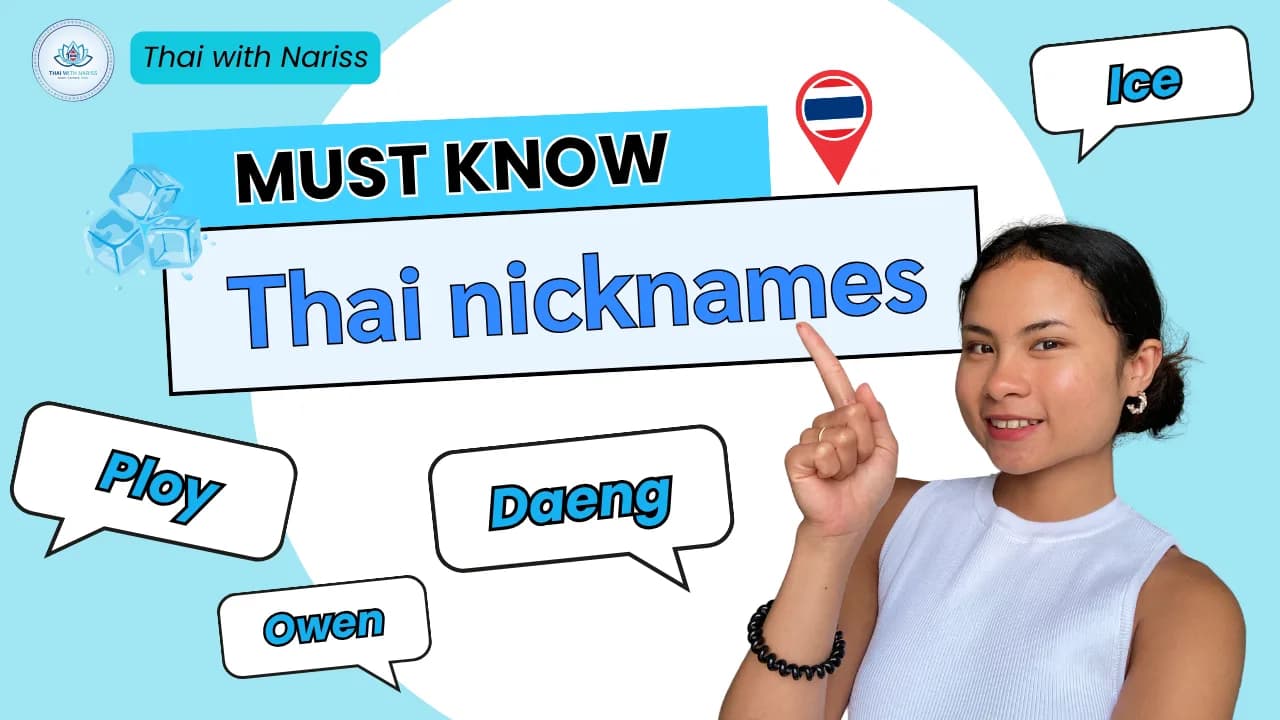
A Thai nickname, called a chêue lên (ชื่อเล่น), is the short play name almost every Thai person goes by in daily life instead of their long official name. Parents choose it in the first days after birth, friends and family use it forever, and most Thais answer to it more readily than to the name on their ID.
In Thailand, a nickname is a sign of closeness. The moment someone hands you theirs, you have stepped past the formal introduction into something friendlier. It is the same warmth that sits behind saying I love you in Thai, where the small everyday words carry all the affection. Below is how these names work, and how to ask for one.
Chêue Lên: Why Every Thai Has Two Names
Thai people carry two names that live in separate worlds. The official one, the chêue jing (ชื่อจริง), is often long, drawn from Sanskrit or Pali, and can run four or five syllables. You will see it on a passport or a bank form and almost nowhere else. The nickname, the chêue lên, is usually one short syllable, and it does the real work of daily life.
The official name is picked with care, and it always means something. Parents often choose it by the day of the week the baby was born or by their zodiac sign, and many now go for rare Sanskrit names nobody else in the class will have. The ending often gives it away. A lot of women's official names end in พร (phawn), which means blessing, as in วารีพร (Wareepawn). Men's names often end in ศักดิ์ (Sak), as in เกียรติศักดิ์ (Giattisak), or in พงศ์ (Phong), as in ณัฐพงศ์ (Natthaphone).
The nickname arrives early. Parents pick it within days of a baby being born, long before the child can object, and it stays for the rest of their life. Your boss uses it. Your grandmother uses it. If you are just starting to learn Thai, this is the name you will actually hear and use, so it is worth understanding where these little names come from.
Classic Thai Nicknames and Their Meanings
Traditional nicknames are drawn from plain, everyday things: a size, a color, an animal, a fruit, a flower. A parent looks at a newborn, sees something small and pink, and the name writes itself. Here are some of the most common ones you will meet.
| Thai | Pronunciation | English |
|---|---|---|
| เล็ก | lék | Small, little |
| น้อย | nói | Little one, often a younger child |
| ใหญ่ | yài | Big |
| แดง | daeng | Red |
| หมู | mǔu | Pig |
| ไก่ | gài | Chicken |
| นก | nók | Bird |
| บัว | bua | Lotus |
| พลอย | phloi | Gem, sapphire |
เล็ก
lék
Small, little
น้อย
nói
Little one, often a younger child
ใหญ่
yài
Big
แดง
daeng
Red
หมู
mǔu
Pig
ไก่
gài
Chicken
นก
nók
Bird
บัว
bua
Lotus
พลอย
phloi
Gem, sapphire
You will meet a lot of Leks. It is probably the single most common nickname in the country, and I have taught more than one student who worked in an office with three of them.
Wait, Your Friend Is Called Pig?
The first time a student hears that their lovely Thai colleague is called Mǔu, Pig, they think they misheard. They did not. And nobody means it unkindly.
The reason is simple. Parents want a word that is easy to say and easy to remember. Often it comes from how the baby looks, and sometimes it rhymes with the name of a brother, a sister, or a cousin. A name like Mǔu sounds soft and familiar to a Thai ear, the way a childhood name should.
The Modern Wave: Boss, Bank, Benz, and Ice
Walk into a Bangkok co-working space today and the nicknames sound very different. Younger Thai parents have moved toward short English words, and you will meet people named Boss, Bank, Benz, Ice, Gift, and Beam. Some carry an aspiration, like Boss or Benz. Others are just a sound the parents liked.
| Thai | Pronunciation | English |
|---|---|---|
| บอส | báwt | Boss |
| แบงก์ | báeng | Bank |
| เบนซ์ | ben | Benz (the car) |
| ไอซ์ | ai | Ice |
| กิ๊ฟ | gíf | Gift |
| บีม | biim | Beam |
บอส
báwt
Boss
แบงก์
báeng
Bank
เบนซ์
ben
Benz (the car)
ไอซ์
ai
Ice
กิ๊ฟ
gíf
Gift
บีม
biim
Beam
The newest nicknames are getting longer. Parents now pick English words of two or three syllables, like Google, Photo, or Poster, because they sound international and up to date.
How to Ask Someone's Nickname
Because the nickname is the name you will actually use, asking for it early is normal and welcome. The key phrase is chêue lên à-rai, what is your nickname. Add your polite particle to soften it: khráp if you are a man, khá if you are a woman asking a question.
| Thai | Pronunciation | English |
|---|---|---|
| ชื่อเล่นอะไร | chêue lên à-rai? | What is your nickname? |
| ชื่อเล่นอะไรครับ / คะ | chêue lên à-rai khráp / khá? | What is your nickname? (polite) |
| ชื่อเล่นชื่อ... | chêue lên chêue... | My nickname is... |
| เรียกฉันว่า... | rîak chǎn wâa... | Call me... |
ชื่อเล่นอะไร
chêue lên à-rai?
What is your nickname?
ชื่อเล่นอะไรครับ / คะ
chêue lên à-rai khráp / khá?
What is your nickname? (polite)
ชื่อเล่นชื่อ...
chêue lên chêue...
My nickname is...
เรียกฉันว่า...
rîak chǎn wâa...
Call me...
When you give your own name, most Thais will happily take an English first name as your nickname. If yours is hard to say in Thai, you can offer a shorter version, and it will spread through the room in minutes.
Real Name or Nickname: Which One Do You Use?
Almost every social setting runs on nicknames. You use them with friends, coworkers, shopkeepers, and the person cutting your hair. The full official name comes out only for paperwork, a first formal introduction in a business meeting, or a government office.
Titles ride along with the nickname too. A doctor is Mǎw plus their name, a teacher is Khruu (ครู, khruu) or Khun Kruu (คุณครู) plus their name. That last one is the reason my students call me Kru Nariss rather than anything longer or more formal. If you want the fuller story of who I am and how I teach, it is on my about page. The short version: in a Thai classroom, warmth comes first, and the name reflects it.
Match the Nickname
Here is a quick check. Four common nicknames are below, along with four meanings in a jumbled order. Match each name to its meaning, say your guesses out loud, then look at the answers underneath.
Nicknames: 1. Lék, 2. Nók, 3. Phloi, 4. Mǔu.
Meanings: A. Gem, B. Bird, C. Small, D. Pig.
Answers:
- Lék: C. Small
- Nók: B. Bird
- Phloi: A. Gem
- Mǔu: D. Pig
If you got all four, you already read Thai nicknames better than most visitors who have lived here for years.
Picking a Thai nickname of your own is one of the friendliest ways to start feeling at home in the language. Saying it well is the next step. My Speaking Thai A1 course has a whole lesson on introducing yourself, after the ones on tones and polite particles, so the first sentence you say to a new Thai friend comes out the way they would say it.