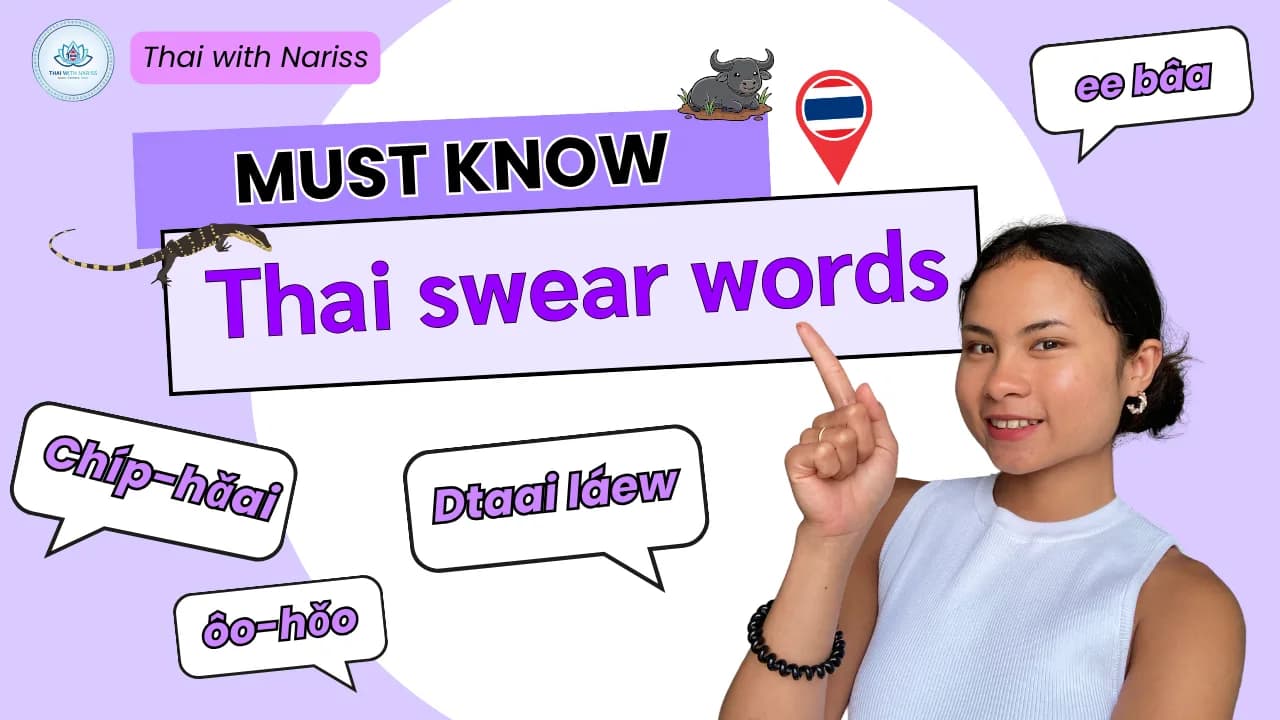
Thai swear words run from mild grumbles all the way to words that can start a fight, and the most common strong one is hîa (เหี้ย), literally a monitor lizard. I teach these words so my students can recognize them when a Thai drama gets heated or someone is genuinely angry, not so they can use them.
If you have read my guide to Thai greetings, you know Thai politeness is built on particles and hierarchy. Swearing runs on the same machinery, just turned inside out: the same words can be warm between two old friends and explosive between strangers. Let me show you where the lines are.
Why I Teach My Students Swear Words
Some students are surprised I bring this up at all. The reason is simple. You are far more likely to hear these words than to need them. They turn up in songs and Thai lakorn dramas, or in a comment shouted across a busy road. If you are learning Thai as a beginner, knowing what you just heard is a safety skill. It tells you when a situation is friendly teasing and when someone is actually angry with you.
So this is a comprehension lesson. I will tell you what each word means, how rough it really is, and what a Thai person would say instead in polite company. What you do with that is your business, but my honest advice is to keep almost all of it in the "recognize, do not repeat" column.
The Pronoun Danger Zone: Guu and Mueng
The two words that catch out every learner are not curses at all. They are pronouns. Guu (กู) means "I" and mueng (มึง) means "you". Between two friends who grew up together, they are completely normal, even affectionate, the way close friends anywhere drop their manners with each other. You will hear teenagers and old buddies using them all day.
Point the same two words at a stranger, a colleague, or anyone older than you, and they become an insult. You are telling that person you have no respect for them. This is why I warn students never to copy guu and mueng from a friend, however natural it sounds coming from them. The word is fine. The relationship behind it is what makes it safe or dangerous.
| Thai | Pronunciation | English |
|---|---|---|
| กู | guu | I / me (vulgar)Fine between close friends, insulting to anyone else |
| มึง | mueng | you (vulgar)Same rule, never use with elders or strangers |
| กูไม่รู้ | guu mâi rúu | I don't know (rough)Casual among friends, rude in public |
กู
guu
I / me (vulgar)
Fine between close friends, insulting to anyone else
มึง
mueng
you (vulgar)
Same rule, never use with elders or strangers
กูไม่รู้
guu mâi rúu
I don't know (rough)
Casual among friends, rude in public
Mild: Everyday Frustration Words
These are the words a Thai person mutters when they stub a toe or miss the songthaew (สองแถว). They are the equivalent of "damn" or "ugh", and most are safe enough that you will hear them from perfectly polite people having a bad day. Still read the room. Volume and who is nearby change how they land.
| Thai | Pronunciation | English |
|---|---|---|
| เวร | ween | Damn itMild, "just my luck" |
| เวรกรรม | ween-gam | What did I do to deserve thisDismay at bad luck, refers to karma |
| บ้า | bâa | Crazy, nutsOften playful. ไอ้บ้า (âi-bâa) teases a male friend, อีบ้า (ee-bâa) a female friend |
เวร
ween
Damn it
Mild, "just my luck"
เวรกรรม
ween-gam
What did I do to deserve this
Dismay at bad luck, refers to karma
บ้า
bâa
Crazy, nuts
Often playful. ไอ้บ้า (âi-bâa) teases a male friend, อีบ้า (ee-bâa) a female friend
The Strong Ones, With Warnings
Now the real ones. These ones really are offensive. Hearing them tells you a conversation has gone somewhere serious. Aimed at you, they are meant to wound. I am listing them so you can recognize them, and I would ask you not to use any of them with a Thai person unless you truly understand the friendship you are in.
| Thai | Pronunciation | English |
|---|---|---|
| ห่า | hàa | Damn (harsher)Strong. Refers to plague, stronger than it looks, avoid in polite settings |
| เหี้ย | hîa | Bastard, damn itVery strong. Literally a monitor lizard. For a milder version, Thais say เชี่ย (chîa) |
| สัตว์ (สัส) | sàt | Beast, animal, used like "a**hole"Strong |
| ควาย | khwaai | Buffalo, meaning stupid or denseMedium. What you call someone you think is not smart |
| ชิบหาย | chíp-hǎai | Screwed, "oh hell"Strong |
| อีดอก | ee-dòk | Bi*chStrong when aimed at a woman. Close girlfriends also throw it at each other as a joke, and it is common in the LGBTQ community |
| กะหรี่ | gà-rìi | ProstituteAn insult aimed at women. It sounds like the Thai word for yellow curry powder, as in ผัดผงกะหรี่ (phàt phǒng-gà-rìi). Most other curries are แกง (gaeng) |
| ควย | khuai | The crudest word for the male anatomyExtreme, vulgar |
ห่า
hàa
Damn (harsher)
Strong. Refers to plague, stronger than it looks, avoid in polite settings
เหี้ย
hîa
Bastard, damn it
Very strong. Literally a monitor lizard. For a milder version, Thais say เชี่ย (chîa)
สัตว์ (สัส)
sàt
Beast, animal, used like "a**hole"
Strong
ควาย
khwaai
Buffalo, meaning stupid or dense
Medium. What you call someone you think is not smart
ชิบหาย
chíp-hǎai
Screwed, "oh hell"
Strong
อีดอก
ee-dòk
Bi*ch
Strong when aimed at a woman. Close girlfriends also throw it at each other as a joke, and it is common in the LGBTQ community
กะหรี่
gà-rìi
Prostitute
An insult aimed at women. It sounds like the Thai word for yellow curry powder, as in ผัดผงกะหรี่ (phàt phǒng-gà-rìi). Most other curries are แกง (gaeng)
ควย
khuai
The crudest word for the male anatomy
Extreme, vulgar
The last one, khuai, sits at the very bottom of the register, along with the explicit anatomical word hǐi (หี) and the crude verb yét (เย็ด) that I will not spell out further. If you hear these thrown at a person rather than muttered in pain, someone is very serious. Treat them the way you would treat the worst words in your own language.
What Thais Say Instead
Here is the more useful half of this lesson. In everyday life, most Thais reach for a soft exclamation, not a curse. These are what you actually want in your own mouth. They let you react to a shock or a mess without anyone raising an eyebrow, and they sit right alongside the everyday basic Thai phrases I teach first.
| Thai | Pronunciation | English |
|---|---|---|
| ตายแล้ว | dtaai láew | Oh no, oh my goodness (literally "already dead") |
| คุณพระช่วย | khun-phrá chûai | Good heavens |
| แย่แล้ว | yâe láew | Oh no, this is bad |
| โอ้โห | ôo-hǒo | Wow (surprise) |
| โธ่ | thôo | Aw, come on (sympathy or mild dismay) |
| อุ๊ย | úi | Oops, oh! |
ตายแล้ว
dtaai láew
Oh no, oh my goodness (literally "already dead")
คุณพระช่วย
khun-phrá chûai
Good heavens
แย่แล้ว
yâe láew
Oh no, this is bad
โอ้โห
ôo-hǒo
Wow (surprise)
โธ่
thôo
Aw, come on (sympathy or mild dismay)
อุ๊ย
úi
Oops, oh!
Jai Yen: Why Shouting Backfires in Thailand
There is a cultural reason the polite exclamations matter more here than in many countries. Thai social life runs on jai yen (ใจเย็น), a "cool heart", staying calm and unbothered. Its opposite, jai ráwn (ใจร้อน) or "hot heart", is not admired. When someone loses their temper and starts swearing in public, the person who explodes is usually the one who loses face (sǐa nâa, เสียหน้า), even if they were wronged.
So if a deal goes bad or a driver cuts you off, the winning move in Thailand is almost always to stay quiet and smile. Swearing back rarely gets you what you want, and it marks you as someone who cannot keep a cool heart. That is worth remembering before any of the words above leave your mouth.
Can You Recognize These? A Little Quiz
Four quick ones. Read each line, decide what was said and how rude it is, then check the answer underneath.
1. In a Thai drama, a furious character spits out "ไอ้เหี้ย!" (âi-hîa). What did they say?
Answer: roughly "you bastard", built on hîa, the monitor-lizard word. It is one of the strongest everyday insults. Aimed at a person, it means real anger.
2. Two old friends meet and one says "มึงไปไหนมา" (mueng bpai nǎi maa). Is this an insult?
Answer: no. Mueng just means "you" here, and the sentence is "where have you been?" Between close friends it is normal and friendly. The same words to a stranger or an elder would be a serious insult.
3. Your Thai friend drops her phone in the pool and says "เวรกรรม" (ween-gam). Is she cursing at you?
Answer: no. Ween-gam is a mild "just my luck". She is complaining about her own bad luck, not about you.
4. Someone calls a slow driver "ควาย" (khwaai). What are they calling them?
Answer: a buffalo, meaning stupid. Medium rudeness. Common, but still an insult you would not say to someone's face lightly.
Knowing which words are playful and which can end a friendship takes a real ear, and that ear is built on polite, everyday Thai. My Speaking Thai A1 course starts there, with the tones and the polite particles, all in my voice so you can copy them. Once polite Thai feels normal to you, a rude word stands out the moment you hear it.